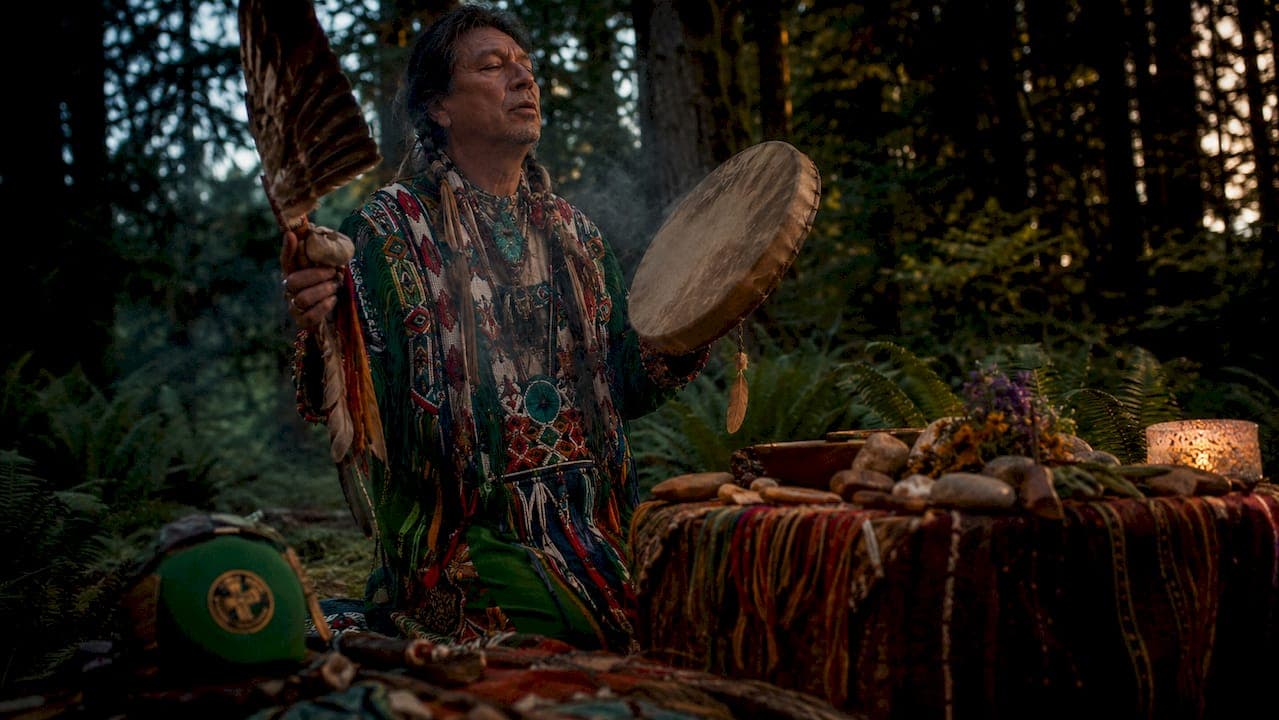
Shamanic medicine is defined as a healing practice that restores balance to the soul and spirit, treating energetic and spiritual imbalances as the root causes of illness. The term comes from the Evenki word šaman, and the practice itself is what anthropologists formally call shamanism. Understanding what shamanic medicine means requires looking beyond symptoms. Shamans serve as mediators between the visible world and the spirit world, entering altered states of consciousness to retrieve lost soul parts, remove harmful energies, and restore a person's connection to their deeper self. This guide covers the history, core techniques, cultural roles, and practical applications of shamanic healing practices for anyone ready to engage with this ancient tradition.
What does shamanic medicine mean at its core?
Shamanic medicine is defined as a technique of religious ecstasy in which a healer mediates between the human and spirit worlds to restore balance. The focus is on mending the soul and spirit, not just relieving biological symptoms. This distinction separates shamanic medicine from most conventional treatments.
The core premise is that illness begins in the energetic or spiritual body before it manifests physically. A shaman diagnoses and treats the spiritual cause, whether that is soul loss, intrusive energy, or a severed connection to one's power source. Physical recovery follows when the spirit is whole again.
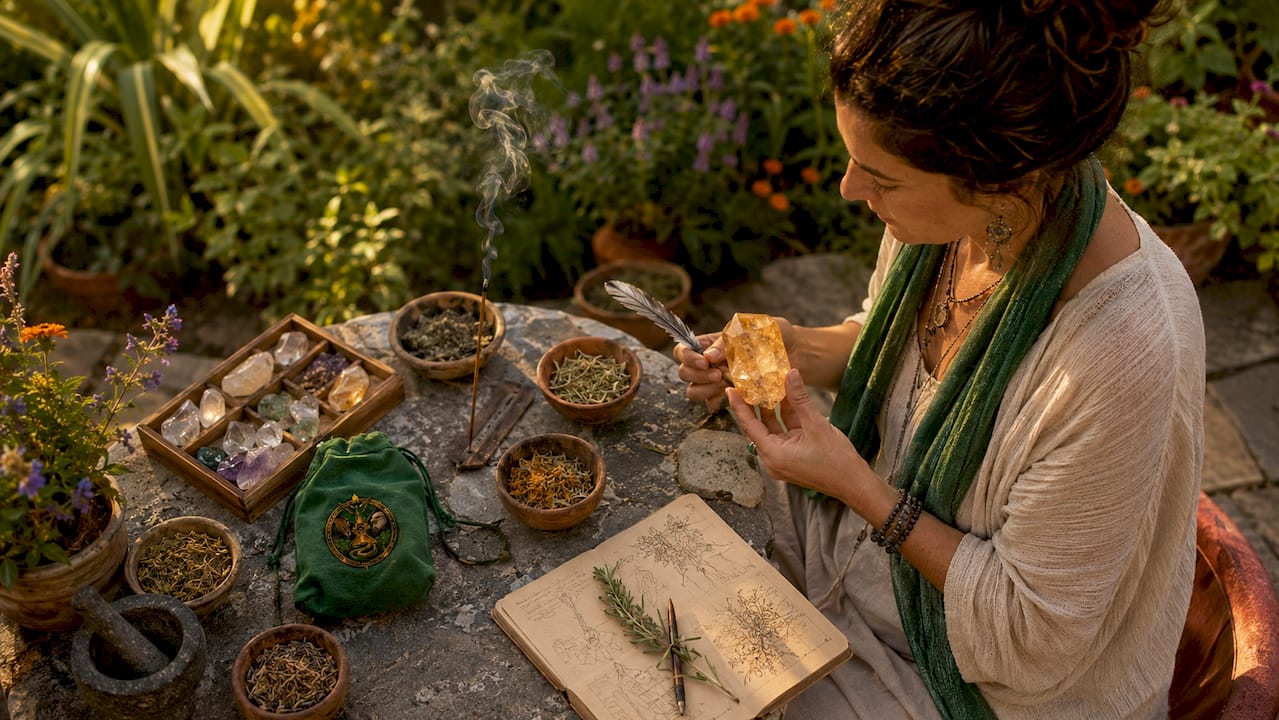
Soul loss is the most widely recognized concept in shamanic medicine. It describes the fragmentation of a person's vital essence in response to trauma, grief, or shock. The shaman's job is to locate those lost fragments and return them, a process called soul retrieval.
How ancient and widespread is shamanic healing across cultures?
Shamanic practices have existed for at least 32,000 years and appear on every inhabited continent. The earliest definitive evidence dates to roughly 30,000 BCE, preserved in Paleolithic cave paintings and burial artifacts. That timeline makes shamanism one of the oldest recorded forms of human healing.
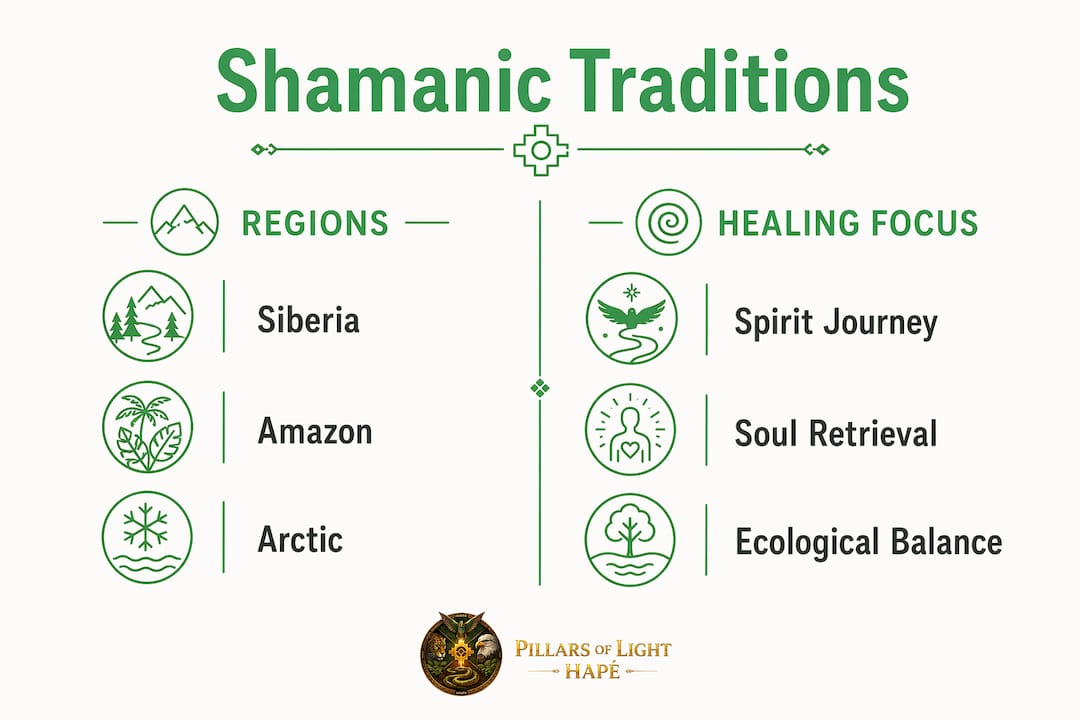
What makes this history remarkable is that shamanic traditions evolved independently across cultures that had no contact with each other. The Siberian Tungus, the Amazonian Shipibo, the Lakota of North America, and the San people of southern Africa all developed parallel healing systems built around spirit mediation and altered consciousness. Independent evolution across such diverse cultures signals that shamanic medicine addresses something fundamental in human experience.
The table below shows how shamanic traditions appear across regions with distinct cultural expressions but shared core functions.
| Region | Tradition | Core healing focus |
|---|---|---|
| Siberia and Central Asia | Tungus shamanism | Spirit journeys, ancestor mediation |
| Amazon Basin | Shipibo, Yawanapi | Plant medicine, energy clearing |
| North America | Lakota, Ojibwe | Power animal retrieval, ceremony |
| West Africa | Vodun traditions | Ancestral healing, community ritual |
| Australia | Aboriginal healing | Dreamtime, land and spirit connection |
Anthropologists caution against treating shamanism as a single unified religion. It is culturally diverse with independently evolved practices serving broad social and spiritual functions. Recognizing that diversity is the first step toward engaging with any tradition respectfully.
What are the core techniques used in shamanic medicine?
Shamanic healing sessions operate within non-ordinary reality, targeting spiritual causes like soul loss rather than symptoms alone, and typically last 60–90 minutes. The shaman enters an altered state of consciousness to access information and perform healing work on behalf of the person receiving care.
The primary techniques used in shamanic healing include:
- Soul retrieval. The shaman journeys to locate and reintegrate fragmented soul parts lost through trauma, illness, or emotional shock. Recipients often report feeling more present and grounded after this work.
- Energy extraction. Intrusive energies or spiritual blockages are identified and removed from the person's energy body. This technique addresses conditions that feel stuck or resistant to other forms of treatment.
- Power animal retrieval. The shaman locates a protective spirit ally for the person and returns it to strengthen their life force and resilience.
- Divination and guidance. The shaman receives information from spirit helpers about the source of illness or the direction a person needs to take.
- Plant medicine and ceremonial tools. Substances like Amazonian Hapé and other master plants in healing facilitate deeper altered states and support the energetic work.
The altered state itself is induced through specific methods. Rhythmic drumming at 4–4.5 Hz induces theta brainwaves, the same frequency range associated with deep meditation and hypnagogic states. This is why the drum is called the shaman's horse in many traditions. It carries the practitioner into non-ordinary reality reliably and safely.
Pro Tip: If you attend a shamanic healing session, bring a journal. The images and impressions that surface during the journey often carry meaning that becomes clearer over the days that follow.
How does shamanic medicine differ from conventional medicine?
Shamanic medicine targets root spiritual causes rather than managing symptoms. Shamanic rituals function as a complex social and energetic technology distinct from biomedical models, addressing ancestral and spiritual disruptions that conventional medicine does not recognize as clinical categories.
The table below compares the two approaches across key dimensions.
| Dimension | Shamanic medicine | Conventional medicine |
|---|---|---|
| Cause of illness | Spiritual, relational, or energetic imbalance | Biological, chemical, or structural dysfunction |
| Treatment focus | Soul and spirit restoration | Symptom relief and physical repair |
| Practitioner role | Neutral channel for spiritual forces | Trained clinician applying evidence-based protocols |
| Community involvement | Central to healing process | Largely individual and private |
| Duration of healing | Extends beyond session through integration | Defined by treatment course |
The practitioner's role in shamanic medicine is described through the concept of the "hollow bone." The hollow bone concept describes the shaman as a neutral channel who removes ego from the process, emphasizing that healing is done by spiritual forces rather than the shaman's personal power. This is a meaningful distinction. The shaman does not heal through personal authority but through clear alignment with something larger.
Shamanic medicine also integrates community, ancestral, and ecological dimensions that biomedical models exclude entirely. A shaman treating a person with chronic illness may address that person's relationship to their ancestors, their land, and their community, not just their body.
Pro Tip: Shamanic healing works best as a complement to, not a replacement for, conventional medical care. Bring both to the table when facing serious illness.
What social and cultural roles does shamanic medicine serve?
Illness in shamanic traditions is interpreted as relational disharmony or a moral breach requiring ritual repair, not just a private physical event. This framing makes healing a community matter, not just an individual one. The shaman mediates between visible and invisible domains to restore sacred and social balance simultaneously.
Shamanic healing rituals serve several social functions beyond individual recovery:
- Cultural transmission. Healing ceremonies carry and reinforce the values, stories, and cosmology of a community across generations.
- Conflict resolution. Shamans often mediate disputes by addressing the spiritual dimension of social ruptures, restoring relational harmony alongside physical health.
- Collective identity. Shared ritual creates belonging. Healing ceremonies bind communities together through shared meaning and sacred practice.
- Moral restoration. When illness is understood as a consequence of broken relationships or violated sacred agreements, the healing ritual restores moral order as much as physical health.
Modern adaptations of shamanic medicine maintain these social healing functions, even when practiced outside indigenous communities. Ceremonial circles, group healing sessions, and Amazonian healing traditions all carry this relational dimension forward. The healing is never only about one person.
Respecting this social and cultural depth matters. Engaging with shamanic medicine means engaging with living traditions that belong to specific peoples and places. Approaching that engagement with humility and genuine curiosity is not optional. It is the foundation of ethical participation.
How can you engage with shamanic medicine today?
Shamanic healing is not a religion. It is a set of practical energy-based techniques accessible regardless of a person's belief system or background. That accessibility makes it one of the most broadly applicable healing modalities available today.
Here is what to expect when engaging with shamanic healing:
- Find a practitioner with clear lineage or training. Ask about their teachers, their tradition, and how they approach ethical sourcing of any plant medicines used. Transparency here is a sign of integrity.
- Prepare with intention. Before a session, reflect on what you are seeking. Soul retrieval, energy clearing, and guidance work all benefit from a clear and honest question.
- Receive the session openly. Most sessions involve lying down while the shaman journeys on your behalf, often with drumming or ceremonial tools. Your role is to stay present and receptive.
- Integrate actively after the session. Post-session integration is essential. Without it, session benefits may be superficial or short-lived. Journaling, time in nature, and reduced stimulation in the days following a session all support lasting change.
- Engage with ceremonial tools respectfully. Tools like Hapé, kuripes, and tepis are not accessories. They are sacred ceremonial tools with specific protocols and purposes rooted in living traditions.
Ethical engagement also means supporting the communities whose traditions you are drawing from. Seek out practitioners and suppliers who prioritize ethical sourcing in plant medicine and direct support for indigenous knowledge holders.
Key Takeaways
Shamanic medicine is a soul-centered healing practice that treats spiritual and energetic imbalances as the root causes of illness, requiring both skilled ritual work and active integration by the person receiving care.
| Point | Details |
|---|---|
| Core definition | Shamanic medicine restores soul and spirit balance, treating spiritual causes rather than symptoms alone. |
| Ancient and global | Shamanic practices date back at least 32,000 years and evolved independently on every inhabited continent. |
| Primary techniques | Soul retrieval, energy extraction, and power animal retrieval are the three main healing modalities. |
| Social dimension | Healing rituals address relational and communal ruptures, not just individual illness. |
| Integration is required | Active post-session integration by the recipient determines whether healing takes lasting hold. |
Why shamanic medicine still speaks to something real
The first time I sat with a genuine shamanic healing session, I expected ritual theater. What I found was something far more grounded. The shaman worked quietly, without performance, and what surfaced in me was not mystical. It was specific. Old grief I had filed away, a sense of disconnection I had normalized, and a clarity I had not felt in years.
What strikes me most about shamanic medicine is that it refuses to separate the personal from the relational. You are not healed in isolation. You are healed in relationship, to your ancestors, your community, the land, and the living world around you. That is not a poetic idea. It is a structural feature of every shamanic tradition I have studied.
The modern wellness world often strips ancient practices down to their most marketable elements. Shamanic medicine resists that reduction when it is practiced with integrity. The depth is in the whole system, not just the techniques. Approach it with that understanding, and it will offer something no symptom-focused treatment can.
— Manifest Light
Authentic ceremonial tools from Pillars of Light hap'e
Pillars of Light hap'e carries 75+ varieties of traditional Amazonian Hapé, handcrafted kuripes, tepis, and master plant products, all ethically sourced and shipped from Old Town Spring, Texas.
Every product at Pillars of Light hap'e is selected with respect for the indigenous traditions behind it. The store supports rainforest preservation and cultural continuity through its sourcing partnerships. Whether you are preparing for your first healing session or deepening an established practice, you will find ceremonial tools and Hapé that honor the traditions they come from. Visit Pillars of Light hap'e to explore the full collection and connect with a community that takes these medicines seriously.
FAQ
What does shamanic medicine mean in simple terms?
Shamanic medicine is a healing practice in which a trained practitioner enters an altered state of consciousness to restore spiritual and energetic balance on behalf of a person experiencing illness or distress. It treats the soul and spirit as the root of physical and emotional health.
Is shamanic healing the same as shamanism?
Shamanism is the broader spiritual and cultural system. Shamanic healing refers specifically to the therapeutic techniques within that system, including soul retrieval, energy extraction, and spirit journeying.
How does shamanism work during a healing session?
A shaman uses rhythmic drumming, plant medicines, or meditation to enter a theta brainwave state, then journeys in non-ordinary reality to identify and address the spiritual cause of a person's condition. Sessions typically last 60–90 minutes.
What are the benefits of shamanic medicine?
Shamanic medicine addresses conditions rooted in trauma, soul loss, and relational disconnection that conventional treatments often do not reach. Recipients frequently report increased presence, emotional clarity, and a renewed sense of purpose following sessions.
Do you need to have specific beliefs to receive shamanic healing?
Shamanic healing is not tied to any religion and does not require the recipient to hold specific spiritual beliefs. It functions as a practical set of energy-based techniques accessible to people from any background.