
Ethical sourcing in plant medicine is defined as the practice of obtaining medicinal plants through methods that protect wild populations, respect Indigenous cultural rights, and guarantee product safety from harvest to end user. The role of ethical sourcing in plant medicine spans three interconnected priorities: environmental stewardship, cultural sovereignty, and supply chain integrity. Frameworks like FairWild certification, access and benefit-sharing (ABS) protocols under the Nagoya Protocol, and Indigenous-led governance models each address a different layer of this responsibility. Without all three working together, a supply chain may look clean on paper while still causing ecological damage or cultural harm.
How does ethical sourcing protect medicinal plant sustainability?
Medicinal plant populations face real pressure from rising global demand and climate-driven habitat shifts. Species like Nardostachys jatamansi, harvested for its roots in high-altitude ecosystems, are already showing supply disruptions tied to both overharvesting and changing growing conditions. That combination makes sustainable plant medicine sourcing not a preference but a structural necessity.
Sustainable harvesting methods focus on two core principles: selective harvesting and regeneration rates. Selective harvesting means taking only a portion of a plant population per season, leaving enough biomass for the species to recover. Regeneration rate data tells a harvester how long a specific plant needs before it can be harvested again without long-term population decline. Without that data, even well-intentioned wildcrafting causes cumulative damage.

Third-party certification schemes like FairWild and Fair for Life verify that wild-harvested plants meet documented sustainability standards. FairWild audits cover harvesting volumes, species population assessments, and community benefit distribution. The label "wildcrafted" on a product label carries no legal weight. A FairWild or Fair for Life certification does.
Environmental impact measurement adds another layer of accountability. Life-cycle assessment (LCA) is a tool that quantifies the environmental cost of a product from raw material extraction through processing and distribution. The VULCANO project collects product-specific data to measure the sourcing impact of botanical extracts at this level of detail. That kind of quantitative evidence moves ethical sourcing from a marketing claim into a verifiable standard.
Key sustainability practices to look for in a supplier include:
- Documented regeneration rate data per harvested species
- Third-party audits from FairWild, Fair for Life, or equivalent bodies
- LCA or equivalent environmental impact reporting
- Harvest volume limits tied to population assessments
- Community benefit agreements tied to harvest rights
Pro Tip: Ask any supplier for their most recent third-party audit report. If they cannot produce one, the "sustainably sourced" claim on their label is unverified.
What is the role of Indigenous governance in ethical plant sourcing?
Ethical sourcing from an Indigenous perspective means centering knowledge holders in every decision, not just crediting them in marketing copy. Indigenous-led governance models require that communities hold leadership roles in research design, harvesting agreements, and benefit distribution. That is a fundamentally different standard than consulting communities after decisions have already been made.
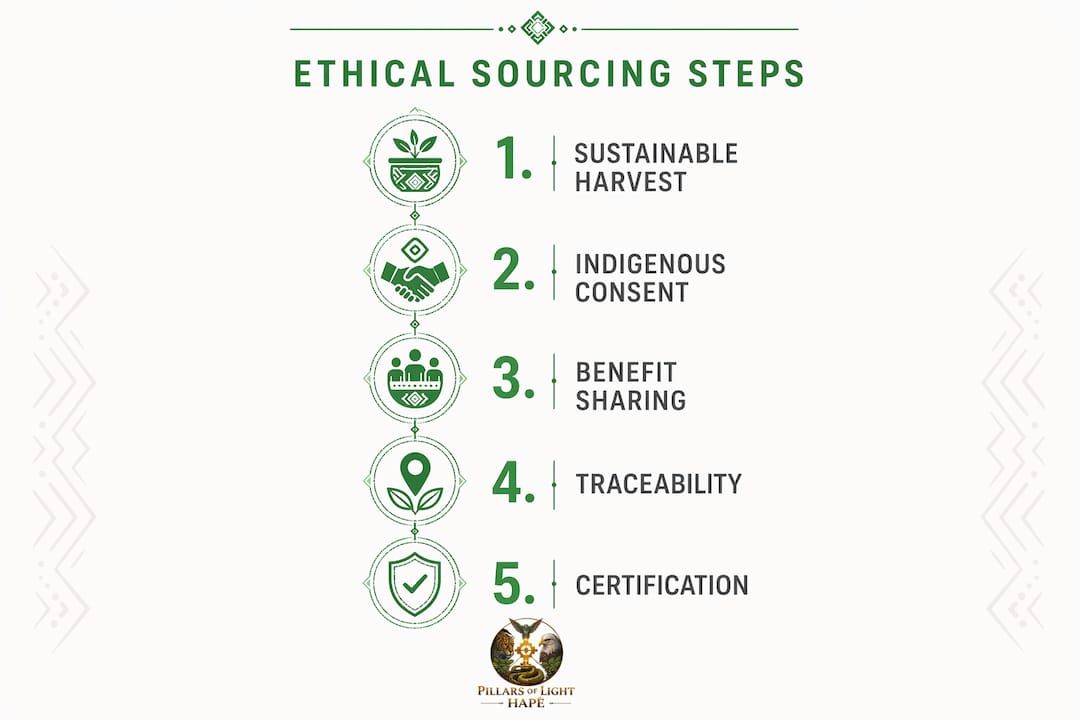
Indigenous Cultural and Intellectual Property (ICIP) rights protect the traditional knowledge, practices, and plant relationships that communities have developed over generations. Biopiracy occurs when companies extract that knowledge or the plants themselves without consent or compensation. It has happened repeatedly in the herbal medicine industry, with corporations patenting compounds derived from plants that Indigenous healers had used for centuries. Ethical sourcing counters biopiracy by requiring documented agreements before any plant or knowledge is accessed.
The best practices identified in Indigenous-led research include:
- Formal permissions obtained before any plant collection or knowledge documentation
- Indigenous leadership in project governance, not just advisory roles
- Benefits-back arrangements that return financial or material value to the source community
- Culturally aligned research methods that respect ceremonial protocols
- Documented agreements rather than verbal understandings
Pro Tip: When evaluating a plant medicine brand's ethics claims, look for named Indigenous partnerships with documented benefit-sharing terms, not vague references to "community support."
Benefit-sharing agreements define exactly what a community receives in exchange for access to their plants or knowledge. These can include royalties, co-ownership of research outputs, capacity-building programs, or direct payments. Vague promises of community support do not meet the standard. Written, enforceable agreements do.
What tools and standards make ethical sourcing verifiable?
The Nagoya Protocol is the primary international legal framework governing access and benefit-sharing for genetic resources and traditional knowledge. It requires prior informed consent (PIC) and mutually agreed terms (MAT) before any resource is accessed. MAT clauses in contracts define permitted uses, geographic scope, and the specific benefits that flow back to the provider community. Without these contractual elements, a company operating in the EU or sourcing from Nagoya Protocol signatory countries faces legal exposure.
Lot traceability is the operational backbone of ethical sourcing at the product level. A certificate of analysis (CoA) issued per lot confirms species identity, plant part used, and contaminant testing results for heavy metals, microbes, and pesticides. A supplier who cannot provide lot-specific CoAs cannot verify what is actually in their product. That gap creates both safety risks and ethical blind spots.
| Standard or Tool | What It Verifies | Limitation |
|---|---|---|
| FairWild certification | Sustainable wild harvest and community benefit | Covers wild-harvested plants only |
| Fair for Life | Fair trade and ethical supply chain | Broader scope, less species-specific |
| Nagoya Protocol (PIC/MAT) | Legal access and benefit-sharing agreements | Requires active legal compliance monitoring |
| GACP/GMP frameworks | Manufacturing quality and consistency | Does not address harvest-level ethics |
| Life-cycle assessment (LCA) | Environmental impact across the supply chain | Resource-intensive to conduct |
| Lot-traceable CoA | Species identity and contaminant safety per batch | Only as reliable as the testing lab used |
Emerging technologies are strengthening traceability at the molecular level. Metabolomics, the analysis of a plant's full chemical profile, can detect adulteration and confirm species identity more reliably than visual inspection. Digital traceability platforms create an auditable record from harvest location through processing and shipping. These tools do not replace certifications but they make fraud significantly harder to hide.
Pro Tip: Request a lot-specific CoA, not a generic product CoA. A generic document may reflect a single test from months or years ago and tells you nothing about the batch you are actually receiving.
Why does ethical sourcing determine product quality and consumer trust?
Poor sourcing practices produce unreliable products. Adulteration, contamination, and batch inconsistency are direct consequences of supply chains that prioritize cost over verification. A 2026 review highlights that traceability and testing reduce waste and support fair supply chains. That finding connects ethical sourcing directly to the physical safety of what reaches the end user.
The World Health Organization's GACP and GMP guidelines provide a framework for producing consistent herbal medicines. GACP covers good agricultural and collection practices at the harvest level. GMP covers manufacturing. Together they create a quality bridge from field to finished product. Suppliers who follow both frameworks produce measurably more consistent and safer products.
Consumer demand for ethically sourced plant medicine is growing, and the reasons go beyond personal values. People who use plant medicine for ceremonial, therapeutic, or wellness purposes want to know that what they are using is what the label says it is. Ethical sourcing practices, including ancestral medicine traditions and verified supply chains, directly support that confidence.
The public health dimension matters too. In low-resource settings where herbal medicine is primary care, contaminated or adulterated products cause real harm. Ethical sourcing is not a premium market feature. It is a baseline safety standard.
Key quality signals tied to ethical sourcing include:
- Lot-traceable CoAs with contaminant testing results
- GACP and GMP compliance documentation from suppliers
- Species and plant part confirmation per shipment
- Third-party certification from FairWild, Fair for Life, or equivalent bodies
- Transparent disclosure of harvest origin and community partnerships
Key Takeaways
Ethical sourcing in plant medicine requires verified sustainability practices, documented Indigenous consent, and lot-traceable quality testing to deliver products that are safe, legal, and culturally respectful.
| Point | Details |
|---|---|
| Certification over labels | FairWild and Fair for Life verify sustainability claims; "wildcrafted" alone means nothing. |
| Indigenous governance is non-negotiable | Documented PIC and benefit-sharing agreements protect communities and prevent biopiracy. |
| Nagoya Protocol sets the legal floor | ABS contracts with PIC and MAT clauses are required for legal access to traditional knowledge. |
| Lot-traceable CoAs confirm safety | Per-batch testing for heavy metals, microbes, and pesticides is the minimum quality standard. |
| GACP and GMP link ethics to quality | WHO frameworks connect harvest-level practices to consistent, safe finished products. |
Why I think "ethical sourcing" needs to mean more than a checkbox
The phrase "ethically sourced" has become so common in plant medicine marketing that it has nearly lost meaning. I have seen brands use it to describe nothing more than paying a middleman a fair price. That is not ethical sourcing. It is a transaction.
Real ethical sourcing requires discomfort. It means sitting with Indigenous knowledge holders and asking what they actually want from a partnership, not what fits neatly into a supplier agreement template. It means accepting that some plants should not be commercialized at all, regardless of demand. It means publishing your CoAs and your benefit-sharing agreements publicly, not just referencing them in a brand story.
Climate change is making this harder, not easier. As medicinal plant ranges shift and yields become less predictable, the temptation to cut corners on sourcing verification grows. That is exactly when the standards need to hold firm. The brands that will still be trusted in ten years are the ones building real relationships with source communities now, not the ones chasing certifications as a marketing tool.
The future of plant medicine sourcing belongs to multi-stakeholder models where Indigenous leaders, environmental scientists, and supply chain managers share decision-making authority. That is not idealism. It is the only model that produces products worth trusting.
— Manifest Light
Pillars of Light hap'e and ethical plant medicine sourcing
Pillars of Light hap'e carries 75+ varieties of traditional Amazonian Hapé (Rapé), handcrafted Kuripes, Tepis, master plant products, and ceremonial tools, all sourced with a stated commitment to Indigenous partnerships and rainforest preservation.
The brand operates from Old Town Spring, Texas, and sources directly through relationships that prioritize cultural respect and community benefit. Every product category, from Hapé blends to ceremonial applicators, reflects the sourcing values this article describes: documented Indigenous relationships, transparency about origins, and respect for the traditions that gave these plants their meaning. Readers who want to put ethical consumption into practice can explore the full range of ethically sourced ceremonial products at Pillars of Light hap'e.
FAQ
What is ethical plant sourcing?
Ethical plant sourcing is the practice of obtaining medicinal plants through methods that protect wild populations, respect Indigenous cultural rights, and ensure product safety through verified supply chains. It requires documented consent, benefit-sharing agreements, and third-party sustainability certification.
What does the Nagoya Protocol require for plant medicine sourcing?
The Nagoya Protocol requires prior informed consent (PIC) and mutually agreed terms (MAT) before accessing genetic resources or traditional knowledge. These contractual terms define permitted uses and the benefits that flow back to the source community.
How does FairWild certification support sustainable plant medicine?
FairWild certification audits wild-harvested plant supply chains for sustainable harvest volumes, species population health, and community benefit distribution. It is one of the few third-party standards that addresses both environmental and social dimensions of wild plant sourcing.
What is a certificate of analysis and why does it matter?
A certificate of analysis (CoA) is a per-lot document confirming species identity, plant part used, and contaminant test results for heavy metals, microbes, and pesticides. A lot-specific CoA is the minimum verification standard for any ethically sourced herbal product.
How does climate change affect ethical sourcing in plant medicine?
Climate change shifts the geographic range and reduces the yield predictability of many medicinal plant species, increasing overharvesting risk. Ethical sourcing frameworks that include regeneration rate monitoring and harvest volume limits become more critical as growing conditions become less stable.