Plant medicine is defined as the use of plant parts, preparations, and phytochemicals to support healing, restore balance, and complement the body's natural recovery processes. The role of plant medicine in healing spans thousands of years of traditional practice and is now formally recognized by the World Health Organization under the framework of traditional, complementary, and integrative medicine. Understanding this role today means looking at three layers: the science behind plant compounds, the cultural and ritual contexts that shape their use, and the real-world safety issues that determine whether a plant remedy helps or harms.
What does the science say about plant medicine in healing?
Plants heal through phytochemicals. These are naturally occurring compounds, including alkaloids, flavonoids, terpenes, and polyphenols, that interact with biological systems in the human body. Penn State researchers frame plant medicine science around these plant-derived chemicals as potential therapeutics, noting that historic use across cultures provides a starting point for modern investigation. That history is not proof of efficacy, but it is a meaningful signal worth studying.
Human clinical studies do exist, and some show real promise. A systematic review of plant-based therapies for leishmaniasis found that plant treatments combined with conventional care produced better outcomes than standard treatment alone, with mild side effects. That result is encouraging. The same review flagged a high risk of bias across studies and inconsistent standardization of plant preparations, which means the findings cannot yet be generalized broadly.
The National Center for Complementary and Integrative Health, known as NCCIH, serves as the federal lead for this research in the United States. NCCIH fact sheets evaluate the safety, effectiveness, and known side effects of specific herbs and supplements. They are one of the most reliable free resources available to anyone researching natural healing with plants.
Pro Tip: Before trying any herbal remedy, search the NCCIH herb database by plant name. You will find a plain-language summary of what the evidence actually shows, not what a product label claims.
Here is what the current evidence landscape looks like:
- Promising evidence: Adjunct use in specific infectious diseases, anti-inflammatory applications, and digestive support
- Inconclusive evidence: Many popular herbal supplements lack rigorous human trials
- Absent evidence: Products making disease-cure claims with no peer-reviewed backing
- Active research: Phytochemical isolation studies identifying compounds for pharmaceutical development
The honest summary is this: plant medicine has real pharmacological activity. The science is growing, but it is uneven. Treating every herb as proven medicine is a mistake. So is dismissing all plant remedies as folklore.
What are the critical safety considerations when using plant medicine?
Product quality is the most underestimated risk in plant medicine. The FDA issued a warning that supplements labeled as tejocote root were actually adulterated with toxic yellow oleander, causing severe adverse effects in people who believed they were taking a traditional weight-loss herb. This case illustrates a hard truth: the label on a supplement does not guarantee what is inside the bottle.
Herb-drug interactions represent a second major risk, particularly for people managing chronic illness or cancer. St. John's wort, one of the most widely used herbal supplements in the world, induces the CYP3A4 enzyme pathway. That induction reduces cancer drug exposure in the body, which can directly undermine chemotherapy effectiveness. This is not a theoretical concern. It is a documented pharmacokinetic effect with clinical consequences.
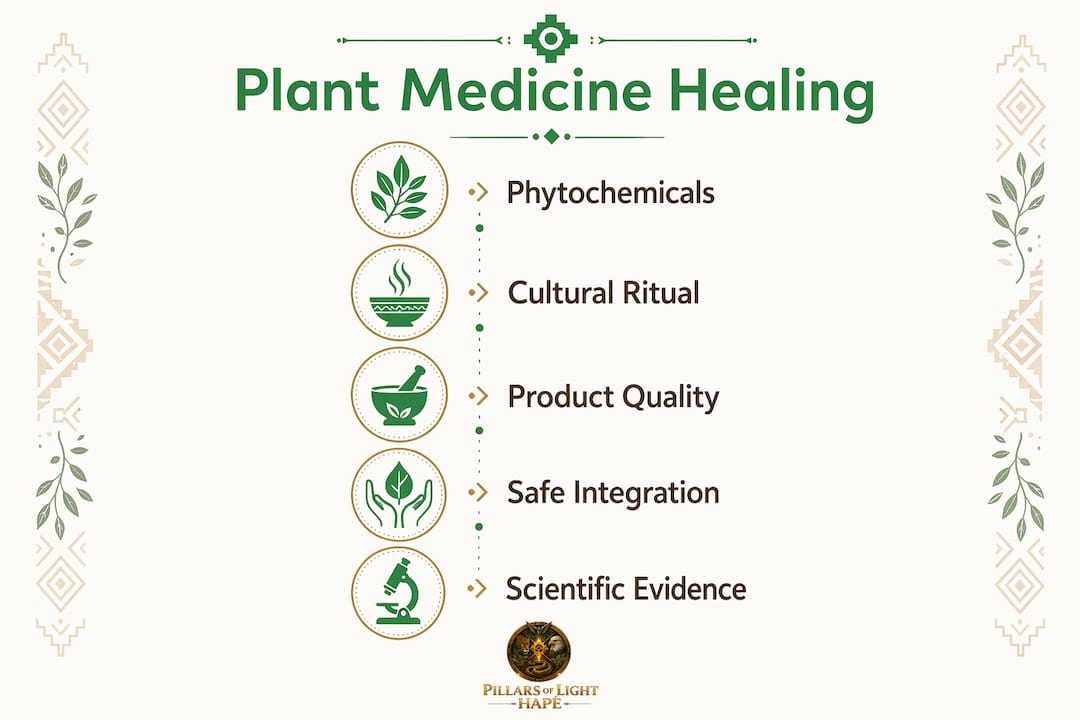
"Plant medicine safety depends on three layers: traditional and ritual use, pharmacological constituents, and real-world product quality. All three influence healing outcomes."
The practical safety checklist for anyone using herbal remedies for healing:
- Verify sourcing: Buy from suppliers who can document origin, testing, and preparation methods
- Check the FDA fraud database: The FDA health fraud database lists unapproved herbal products making illegal disease-cure claims
- Disclose to your doctor: Always tell your healthcare provider what herbs you are taking, especially if you use prescription medications
- Watch for interactions: St. John's wort, kava, and valerian all have documented interactions with common medications
- Start low: Begin with the lowest suggested amount and monitor your body's response before increasing
The FDA's yellow oleander case is a reminder that beneficial pharmacology means nothing if the product you are holding is not what it claims to be. Sourcing and verification are not optional steps. They are the foundation of safe plant medicine use.
How do ritual and intention shape the healing role of sacred plants?
The pharmacological view of plant medicine captures only part of the picture. Across Indigenous Amazonian traditions, African healing systems, and Ayurvedic practice, plants are not used in isolation. They are embedded in ceremony, intention, and relationship. The role of sacred plants in healing within these traditions is inseparable from the context in which they are received.
The WHO's traditional medicine strategy explicitly calls for evidence-based, culturally respectful integration of traditional, complementary, and integrative medicine into health systems. That framing acknowledges something important: stripping a plant from its cultural context and selling it as a capsule is not the same as traditional use. The ritual, the healer's knowledge, and the participant's intention all contribute to the outcome.
The role of intention in plant medicine is not mysticism for its own sake. Intention shapes preparation, attention, and receptivity. When a person enters a healing ceremony with clarity of purpose, they engage differently with the experience. That engagement affects the nervous system, stress response, and psychological processing in measurable ways.
Here is how traditional plant medicine practice structures the healing process:
- Preparation: Dietary and behavioral protocols, often called dietas in Amazonian traditions, prepare the body and mind before plant use
- Ceremony: A structured ritual container, led by a trained practitioner, sets intention and creates safety
- Plant administration: The plant medicine is received in a specific way, with specific tools, at a specific time
- Integration: Post-ceremony reflection and community support help the person process and apply what they experienced
The role of ritual in plant healing is not decoration. It is the delivery system for the medicine's full effect. Removing it reduces plant medicine to pharmacology alone, which misses the depth of what these traditions actually offer.
Pro Tip: If you are new to ceremonial plant medicine, seek out practitioners with documented lineage and training. The quality of the container matters as much as the quality of the plant.
How can you integrate plant medicine into your healing practice safely?
Safe integration starts with honest communication with your healthcare provider. Herb-drug interaction reconciliation is the first clinical step, especially if you take medications for chronic conditions. Your doctor cannot protect you from interactions they do not know about. Disclosure is not optional.
Beyond that conversation, use trusted sources to research what you plan to take. NCCIH fact sheets, peer-reviewed databases like PubMed, and the FDA's health fraud product database give you a factual baseline. Avoid products that claim to cure named diseases. That language is a regulatory red flag and often signals an unverified or adulterated product.
Respect the cultural origins of the plants you work with. Amazonian master plants, for example, carry deep ancestral knowledge developed over generations. Learning about that context, through resources like the ceremonial tools guide from Pillars of Light hap'e, adds meaning and safety to your practice. Cultural respect is not just ethical. It also connects you to the accumulated wisdom that makes these plants effective.
- Consult first: Talk to your doctor before adding any herb to your routine
- Research the plant: Use NCCIH and PubMed, not just product websites
- Source carefully: Choose suppliers who test for purity and can trace their supply chain
- Honor the context: Learn the traditional use before adopting a plant into your practice
- Integrate slowly: Give your body and mind time to respond before adding more
Key Takeaways
Plant medicine heals through a combination of active phytochemicals, cultural ritual, and verified product quality. All three must be present for the practice to be both safe and effective.
| Point | Details |
|---|---|
| Science is promising but uneven | Human studies show real benefits in some conditions, but high bias risk means results cannot be broadly generalized. |
| Product safety is non-negotiable | FDA adulteration cases prove that sourcing and verification protect you more than any label claim. |
| Herb-drug interactions are real | St. John's wort and other herbs alter drug metabolism and can undermine prescription treatments. |
| Ritual and intention matter | Traditional ceremonial contexts shape healing outcomes beyond what pharmacology alone explains. |
| Disclosure protects you | Telling your healthcare provider what herbs you use is the single most protective step you can take. |
What I have learned from years at the intersection of tradition and evidence
People often come to plant medicine from one of two directions. They either arrive as true believers who trust the plant completely and skip the safety steps, or they arrive as skeptics who want a clinical trial before they will consider anything traditional. Both positions miss the point.
What I have found is that the most effective relationship with plant medicine is built on layered respect. You respect the pharmacology by researching what a plant actually does in the body. You respect the tradition by learning where it comes from and how it is meant to be used. And you respect the product by demanding that what you are holding is actually what it claims to be.
The FDA's yellow oleander case stays with me. Someone bought what they believed was a traditional herb. They trusted the label. They were poisoned. That is not a failure of plant medicine. That is a failure of product integrity. The distinction matters enormously.
I also think the Western tendency to isolate the active compound and discard the ceremony is a significant loss. The ritual container, the practitioner's knowledge, the participant's intention: these are not placebo effects to be controlled away. They are part of the medicine. Indigenous Amazonian traditions understood this long before modern neuroscience began studying the psychophysiology of ceremony.
My honest recommendation is this: approach plant medicine with the same rigor you would apply to any health decision. Research it. Verify the source. Talk to your doctor. And then, if the path is clear, receive it with full presence and respect for where it comes from.
— Manifest Light
Pillars of Light hap'e: ceremonial tools for your healing path
Pillars of Light hap'e is an apothecary rooted in Amazonian tradition, based in Old Town Spring, Texas. The store carries 75+ varieties of Hapé, handcrafted Kuripes, Tepis, and master plant products, all ethically sourced with direct respect for Indigenous communities and rainforest preservation. Every product is chosen with the understanding that plant medicine works best when the tool, the tradition, and the intention are all aligned. For those ready to bring ceremonial plant medicine into their practice with integrity, explore the full collection at Pillars of Light hap'e and find the tools that honor the medicine you are working with.
FAQ
What is the role of plant medicine in healing?
Plant medicine supports healing through phytochemicals that interact with the body's biological systems, often used alongside conventional care. The WHO recognizes it within traditional, complementary, and integrative medicine frameworks.
Are herbal remedies scientifically proven to work?
Some herbal remedies show real benefits in human studies, such as plant-based adjuncts in leishmaniasis treatment, but many studies carry a high risk of bias and inconsistent standardization. NCCIH fact sheets provide the most reliable summary of current evidence for specific herbs.
What are the biggest safety risks with plant medicine?
Product adulteration and herb-drug interactions are the two most serious risks. The FDA has documented cases of supplements contaminated with toxic substances, and herbs like St. John's wort can reduce the effectiveness of prescription medications.
How does ritual affect plant medicine healing?
Ritual creates a structured context that shapes intention, attention, and nervous system response, all of which influence how a person experiences and integrates plant medicine. Traditional practitioners view ceremony as an inseparable part of the medicine itself.
How do I know if a plant supplement is safe to buy?
Check the FDA's health fraud product database for unapproved products, buy only from suppliers who test for purity and can document sourcing, and consult your healthcare provider before use, especially if you take prescription medications.