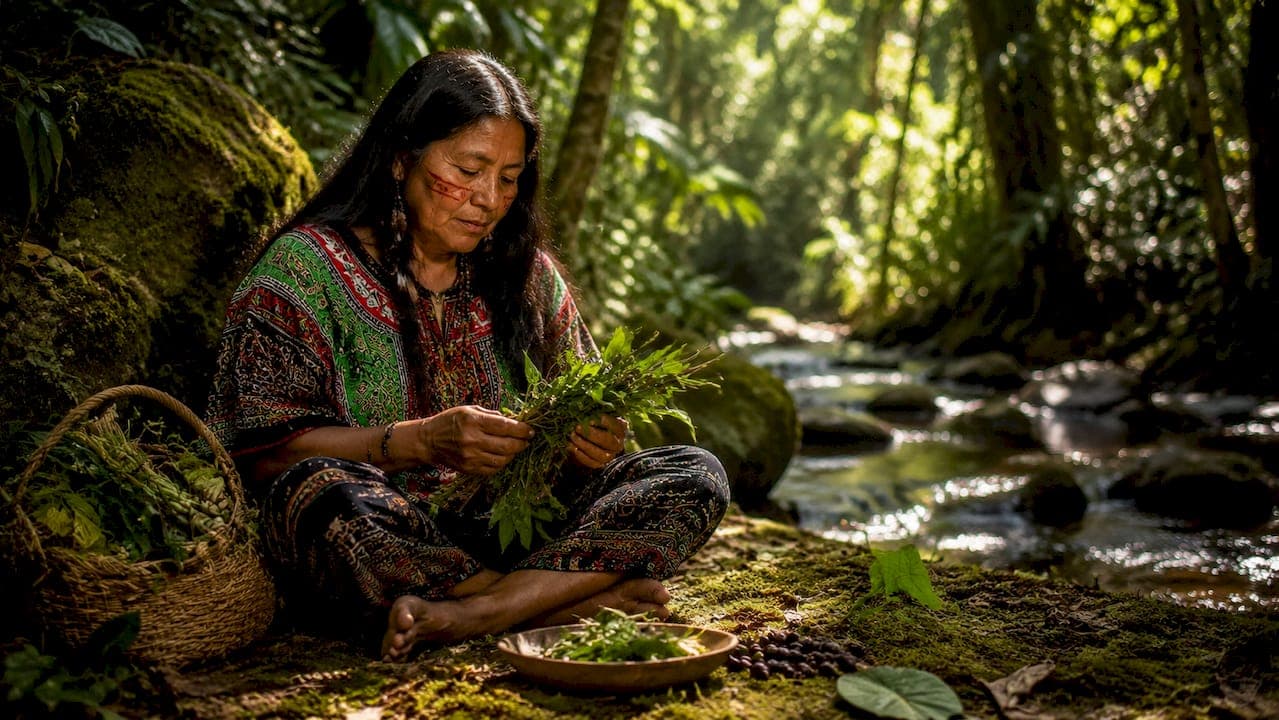
Amazonian plants are defined as sacred living beings within Indigenous cosmologies, serving as spirit allies, teachers, and mediators between the human world and the spirit world. The Amazon contains 10% of all known global species, a biodiversity so vast that Indigenous healers have spent centuries learning its spiritual grammar, not just its chemistry. Plants like ayahuasca and mapacho tobacco are not regarded as substances. They are regarded as conscious beings with intention, capable of teaching, healing, and guiding those who approach them with respect. Understanding why Amazonian plants are sacred requires stepping fully into that worldview, where the forest is alive and every plant has something to say.
Why are Amazonian plants sacred beyond medicine?
Amazonian plants are sacred mediators between human, natural, and spiritual realms. That distinction separates Indigenous plant knowledge from Western pharmacology at its root. A Western framework asks what a plant contains. An Indigenous framework asks who the plant is.
Cultural researchers identify this mediating role as the core of plant sacredness. Plants do not simply produce chemical effects. They carry intention, communicate with practitioners, and participate actively in ceremonies. This is why the term "maestro" appears repeatedly in Amazonian traditions. A maestro is a teacher, and plants are living maestros that taught humans how to combine and use them long before biochemical science arrived to explain the mechanisms.
The relationship between humans and sacred plants is also non-transactional. You do not take from a sacred plant. You enter into a relationship with it. Ethnographic evidence shows that humans receive medicine while protecting the forest and passing knowledge forward. That reciprocity is not metaphor. It is the operating principle of the entire system.
Key reasons Indigenous traditions regard these plants as sacred:
- Spiritual consciousness: Plants are understood to possess awareness and intention, not just biochemical properties.
- Mediating function: They open pathways between ordinary reality and the spirit world during ceremony.
- Ancestral connection: Sacred plants carry the memory of lineages and transmit that knowledge to practitioners.
- Ecological relationship: Honoring plants means protecting the forest that sustains them and the communities that depend on it.
- Healing agency: Plants are active participants in diagnosis and healing, not passive tools.
Pro Tip: If you are new to studying Amazonian plant traditions, read about Indigenous plant medicine before attending any ceremony. Context shapes the entire experience.
How do ayahuasca and tobacco illustrate plant sacredness?
Two plants stand above all others as illustrations of why Amazonian flora holds sacred status: ayahuasca and mapacho tobacco. Each demonstrates a distinct dimension of sacredness, and together they show how the tradition works as a living system.
Ayahuasca: a doorway to spiritual communion
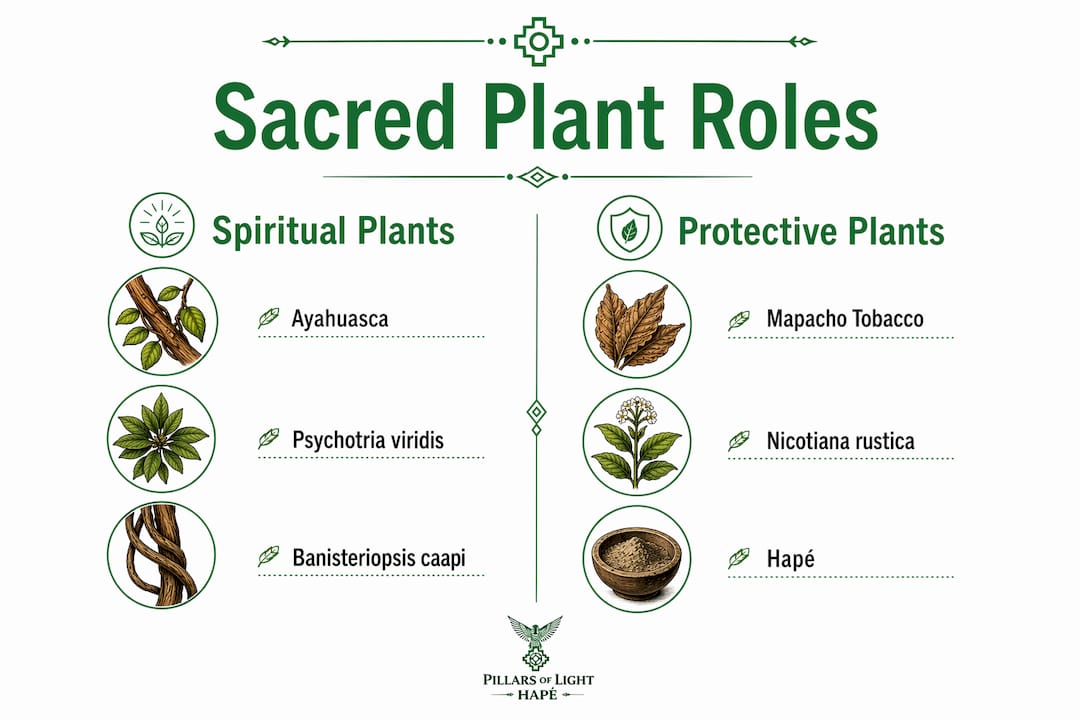
Ayahuasca is not a single plant. It is a preparation combining Banisteriopsis caapi and Psychotria viridis, and Indigenous Amazonian cultures identify this pairing as a doorway to spiritual communion rather than a pharmacological accident. This synergy is recognized among more than 80,000 Amazonian species as uniquely profound. The vine (B. caapi) is considered the teacher. The leaf (P. viridis) amplifies the signal. Together, they create conditions for ancestral communication, spiritual diagnosis, and healing that practitioners describe as a conversation with the forest itself.
Ceremonies involving ayahuasca follow strict protocols. The curandero or ayahuascero prepares through dieta, a period of dietary and social restriction that makes the practitioner receptive to plant communication. Participants are guided through the experience with icaros, sacred songs that direct the plant's energy. The ceremony is not recreational. It is a structured, supervised encounter with a conscious being.
Mapacho tobacco: the master plant of protection
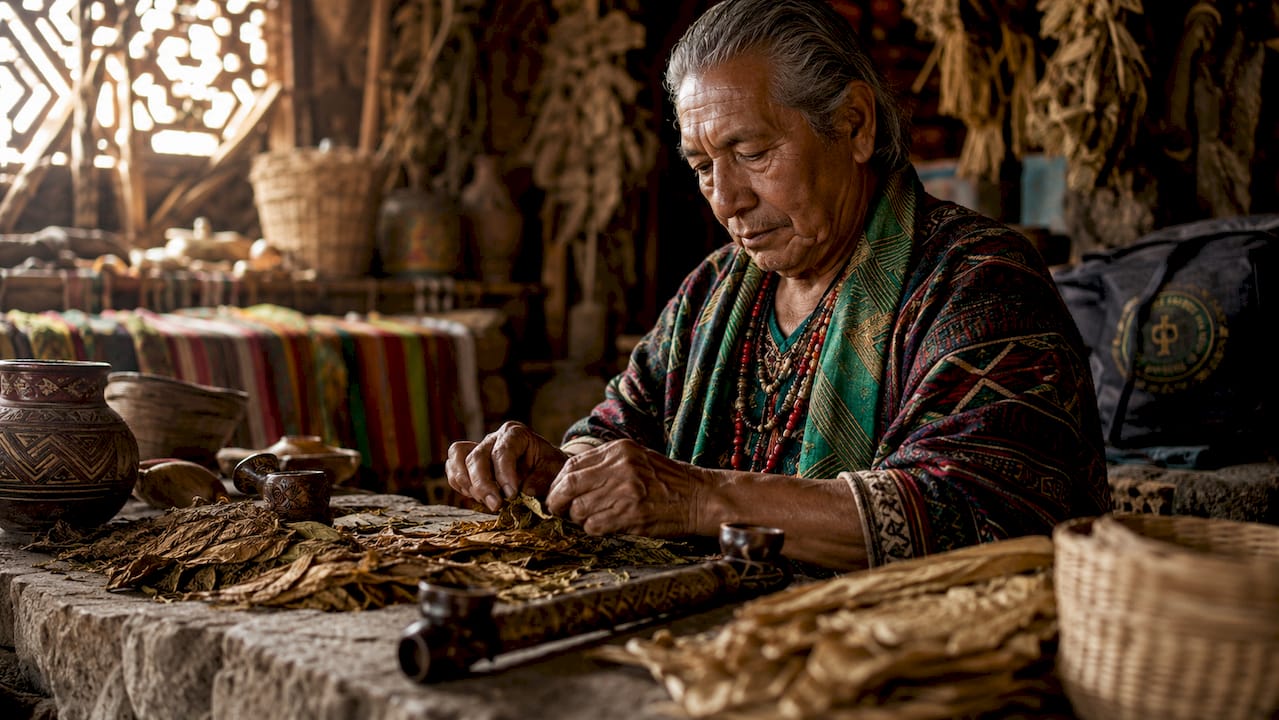
Mapacho (Nicotiana rustica) holds a role in Amazonian ritual that most outsiders do not expect. Sacred plants like mapacho have independent spirit-owners and require careful ceremonial placement and respect. Tobacco in this tradition is a protector, a cleanser, and a direct line of communication with the spirit world. It is blown over participants, used to open and close ceremonies, and administered as Hapé (a powdered ceremonial preparation) through a kuripe or tepi applicator.
The role of tobacco in Amazonian ritual is inseparable from lineage. A healer does not simply decide to work with mapacho. They are trained within a tradition, often over years, learning the protocols that govern how the plant is approached, prepared, and used. Western perspectives frequently misread mapacho as a simple stimulant. That misreading strips the plant of its identity as a master plant requiring ceremonial respect.
| Plant | Primary sacred role | Ceremonial context |
|---|---|---|
| Ayahuasca (B. caapi + P. viridis) | Spiritual communion and ancestral communication | Guided ceremony with curandero and icaros |
| Mapacho (Nicotiana rustica) | Protection, cleansing, and spirit communication | Dieta, Hapé administration, ceremony opening and closing |
Pro Tip: The role of tobacco in plant medicine is best understood through its ceremonial context. Read about plant medicine ceremony types to see how mapacho functions within the larger ritual structure.
How do Indigenous communities transmit sacred plant knowledge?
Sacred plant knowledge does not live in books. It lives in people, in ceremony, and in the relationships between generations. The transmission of this knowledge is one of the most carefully guarded and culturally significant processes in Amazonian societies.
- Kinship and apprenticeship: Knowledge passes from elder to apprentice within family or community lineages. A healer's authority comes from who taught them, not from a credential. This lineage chain is the guarantee of authenticity.
- Ceremonial practice: Ceremonies are not only healing events. They are also teaching events. Apprentices observe, participate, and gradually take on responsibility as their relationship with the plants deepens.
- Dieta and restriction: The practice of dieta, a period of isolation, dietary restriction, and plant ingestion, is how practitioners build a direct relationship with a specific plant. The plant teaches during this period through dreams, visions, and physical sensations.
- Story and song: Icaros and oral narratives encode plant knowledge in forms that survive across generations. A song is not decoration. It is a precise map of how to work with a plant's spirit.
- Ecological stewardship: Transmission of sacred plant knowledge is linked to kinship, cultural survival, and ethical responsibility for stewardship of tradition. Communities that protect their forests protect their knowledge. The two are inseparable.
Commodification threatens this system directly. When sacred plants are extracted from their ceremonial context and sold as experiences or supplements, the lineage chain breaks. The plant remains, but the knowledge that makes it sacred does not travel with it. Preservation of this knowledge is vital for cultural survival and ecological stewardship amid external pressures.
What practical roles do sacred plants play in healing today?
Sacred Amazonian plants serve active healing roles in contemporary Indigenous communities, and those roles extend well beyond what Western clinical frameworks typically recognize. Healing in this tradition addresses physical, spiritual, and psychological dimensions simultaneously. That integration is the point.
Mapacho tobacco offers one of the clearest examples of the role of tobacco in plant medicine applied to measurable outcomes. A 7-day supervised retreat in Loreto, Peru, using Nicotiana rustica administered by traditional healers demonstrated clinically relevant improvements in mood, anxiety, and attention disorders. That result matters because it shows the plant working within its ceremonial context, not extracted from it.
The healing framework in Amazonian traditions covers several interconnected dimensions:
- Physical restoration: Plants address illness at the body level through their direct biochemical and energetic effects.
- Spiritual diagnosis: Healers use plant-assisted states to identify the spiritual root of an illness, which may precede or underlie physical symptoms.
- Psychological integration: Ceremonies create space for processing trauma, grief, and confusion in a structured, supported environment.
- Social harmony: Group ceremonies reinforce community bonds and shared values, functioning as social medicine as much as individual healing.
- Ecological reciprocity: Healing ceremonies often include prayers, offerings, and commitments to the forest, reinforcing the relationship between human health and forest health.
The healing traditions of the Amazon are not alternatives to modern medicine in the competitive sense. They operate from a different premise entirely. The premise is that a human being is not separate from the natural world, and healing means restoring right relationship with it.
Key Takeaways
Amazonian plants are sacred because Indigenous traditions recognize them as conscious beings that mediate healing, spiritual connection, and ecological reciprocity through lineage-based ceremonial practice.
| Point | Details |
|---|---|
| Plants as conscious beings | Indigenous traditions treat Amazonian plants as maestros with intention, not passive botanical specimens. |
| Ayahuasca's sacred pairing | Banisteriopsis caapi and Psychotria viridis together form a recognized spiritual doorway, not merely a chemical reaction. |
| Tobacco's ceremonial role | Mapacho (Nicotiana rustica) functions as a protector and spirit communicator requiring lineage knowledge and ceremonial respect. |
| Lineage-based transmission | Sacred plant knowledge passes through kinship and ceremony, not texts, making cultural preservation inseparable from ecological protection. |
| Healing as integration | Traditional plant healing addresses physical, spiritual, and psychological dimensions together, with documented improvements in mood and anxiety. |
What I have learned from sitting with these traditions
A perspective from Manifest Light
The thing that strikes me most about Amazonian plant traditions is how completely they invert the Western relationship with nature. In the West, we extract. We isolate the active compound, replicate it, and scale it. The plant becomes a raw material. In the Amazon, the plant is the authority. The healer is the student.
I have spent years studying these traditions, and the concept that took me longest to genuinely absorb is reciprocity. Not as a value statement, but as a practical operating principle. The forest gives medicine. You protect the forest. You pass the knowledge. The cycle continues. Break any part of that cycle and the whole thing degrades. That is not mysticism. That is ecology described in spiritual language.
What concerns me about the growing Western interest in plant medicine is the tendency to import the experience while leaving the framework behind. You can source ethical Amazonian ceremonial tobacco. You can attend a ceremony. But if you approach it as a consumer transaction, you have already misunderstood the invitation. The plants are not asking for your money. They are asking for your respect, your attention, and your willingness to be taught.
The role of ancestral wisdom plants in healing is not a trend. It is a living tradition that has survived colonization, commodification, and centuries of misrepresentation. The least we can do is approach it with the seriousness it deserves.
— Manifest Light
Authentic ceremonial tools for respectful practice
For those called to work with Amazonian plant traditions, the quality and origin of your tools matter as much as your intention.
Pillars of Light hap'e offers 75+ varieties of traditionally prepared Hapé, along with handcrafted Kuripes and Tepis sourced with direct respect for Indigenous lineages. Every product reflects a commitment to ethical sourcing in plant medicine and cultural preservation. The apothecary is based in Old Town Spring, Texas, and ships across the country. Whether you are beginning your study of Amazonian ceremonial practice or deepening an existing relationship with these plants, Pillars of Light hap'e provides tools grounded in tradition, not trend.
FAQ
Why are Amazonian plants considered sacred?
Amazonian plants are considered sacred because Indigenous traditions recognize them as conscious beings with spiritual intention that mediate healing and connection between humans and the spirit world. Their sacredness comes from their role as teachers and spirit allies, not solely from their medicinal properties.
Why is Amazonian tobacco sacred in Indigenous traditions?
Mapacho (Nicotiana rustica) is sacred because it functions as a protector, cleanser, and direct channel of spirit communication in ceremony. Its sacred status requires lineage-based knowledge and strict ceremonial protocols that distinguish it entirely from commercial tobacco.
What is the role of tobacco in Amazonian ritual?
Tobacco serves as a master plant in Amazonian ritual, used to open and close ceremonies, cleanse participants, and facilitate communication with plant spirits. It is administered as Hapé through kuripe or tepi applicators and is central to the healer's practice.
How is sacred plant knowledge passed down in the Amazon?
Sacred plant knowledge passes through kinship and apprenticeship, with elders transmitting protocols, songs, and dieta practices to apprentices over years of direct ceremonial experience. This lineage chain is what gives a healer their authority and keeps the tradition intact.
How do I source ethical Amazonian ceremonial tobacco?
Ethical sourcing means tracing the tobacco directly to Indigenous producers who prepare it within traditional ceremonial contexts and lineage frameworks. Look for apothecaries that publicly commit to cultural preservation and direct community relationships, as Pillars of Light hap'e does.