
Fair trade plant medicine is a framework for sourcing medicinal herbs that guarantees fair wages, safe working conditions, ecological sustainability, and transparent supply chains from harvest to shelf. The term covers both wild-harvested and cultivated species, and it goes well beyond what organic certification requires. Where organic standards focus on farming inputs, fair trade standards address social fairness and ecological stewardship at every step. Certification programs like FairWild and Fair for Life set the bar, requiring population monitoring, regeneration planning, and verified traceability. Understanding what is fair trade plant medicine means understanding that the plant in your hands carries a story, and that story should be one of respect.
What is fair trade plant medicine and what principles govern it?
Fair trade plant medicine rests on three pillars: social equity, ecological sustainability, and supply chain transparency. Each pillar carries specific, auditable requirements. A product cannot claim fair trade status simply because it is natural or traditionally harvested.
The social equity pillar requires that harvesters and farmers receive living wages, work in safe conditions, and have access to community benefits. Fair trade certifications fund social development projects including education, healthcare, and clean water infrastructure for farming communities. That investment creates long-term stability rather than short-term extraction.
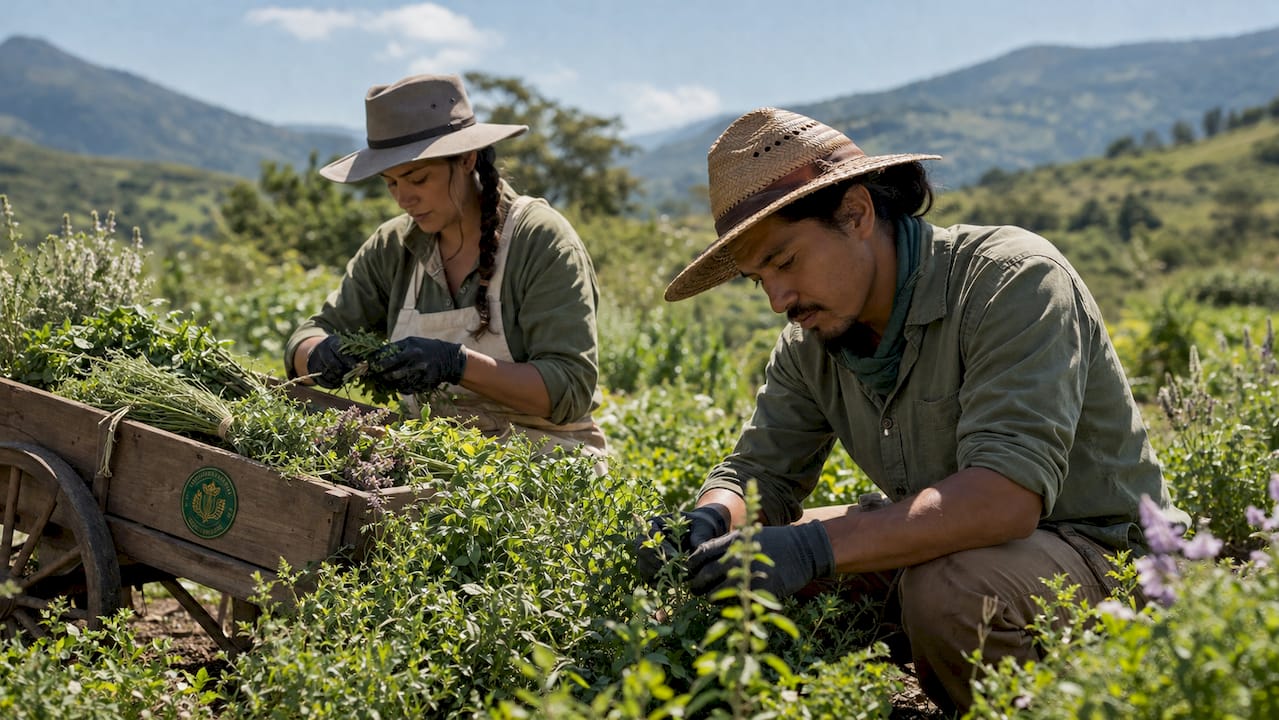
The ecological pillar is where fair trade diverges most sharply from organic. The FairWild standard requires population monitoring and regeneration planning specifically for wild root-harvested species prone to destructive harvesting. This means harvesters must track plant populations over time and respect quotas that prevent collapse. Organic certification carries no such requirement.
The transparency pillar demands documented, traceable supply chains. Every hand the plant passes through must be recorded and verifiable. That traceability protects both the consumer and the source community.
Key standards operating in this space include:
- FairWild: Covers wild-harvested medicinal and aromatic plants, with strict ecological monitoring and harvester welfare requirements.
- Fair for Life: A broader social and fair trade certification applicable to cultivated herbs and processed products.
- Fairtrade International: Primarily covers agricultural commodities but applies to some herbal crops.
- Organic certification (USDA, EU): Governs farming inputs only. No social or ecological monitoring requirements for wild species.
Pro Tip: When you see "organic" on a herbal product, that tells you how the plant was grown. It tells you nothing about whether the harvester was paid fairly or whether the wild population was protected. Look for FairWild or Fair for Life alongside organic to get the full picture.
How does fair trade change the way medicinal plants are sourced?
Fair trade sourcing changes the economics and the relationships at the base of the supply chain. Obtaining over 90% of herbs directly from local farmers and collectors provides the highest supply chain visibility and fair compensation. That direct connection removes intermediaries who typically capture value without adding accountability.
In practice, this looks like long-term contracts with specific farming communities, agreed price floors that do not collapse when global commodity markets dip, and joint planning between buyers and harvesters on harvest volumes. The relationship becomes a partnership rather than a transaction.
The ecological benefits are concrete. Consider baobab and pelargonium sourcing in southern Africa. Both species face pressure from commercial demand, and fair trade frameworks for African medicinal herbs require harvesters to leave sufficient root stock and monitor regeneration between seasons. Without those requirements, commercial demand would deplete wild populations within years.
Quality assurance also improves under fair trade sourcing. Metabolomics and chemical fingerprinting verify authenticity by creating a chemical profile unique to each plant batch. That technique reduces illegal substitution and adulteration, which are common problems in conventional herbal supply chains. Better traceability means better quality for the end user.
The practical steps in ethical sourcing follow a clear sequence:
- Map the source community. Identify who harvests, where, and under what conditions before any purchase agreement is signed.
- Establish price floors. Agree on minimum prices that cover living costs regardless of market fluctuations.
- Set ecological quotas. Define harvest volumes based on population monitoring data, not demand projections.
- Verify with documentation. Require batch records, harvest logs, and third-party audits at each stage.
- Use analytical verification. Apply metabolomics or chemical fingerprinting to confirm species identity and rule out substitution.
"The most important thing is not the certification label. It is the relationship. When you know the people who harvest the plant, you can solve problems that no audit ever catches. That human connection is the foundation of genuine ethical sourcing."
— Ann Armbrecht, as discussed in Following the Herbal Harvest
How does fair trade differ from organic and other certifications?
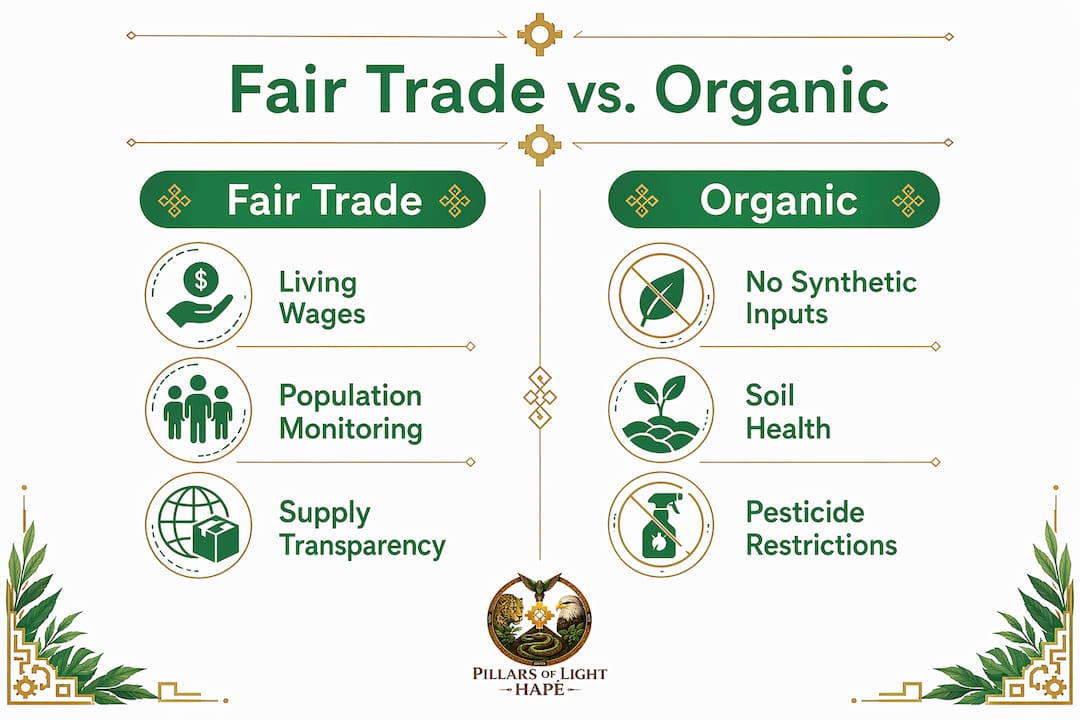
Fair trade and organic certifications address different problems. Organic certification tells you what was not applied to the soil or plant during cultivation. Fair trade certification tells you how the people who grew or harvested that plant were treated, and whether the ecosystem they work in was protected. Both matter. Neither replaces the other.
The table below shows where each framework focuses its requirements:
| Criteria | Fair trade (FairWild / Fair for Life) | Organic (USDA / EU) |
|---|---|---|
| Farmer wages and labor rights | Required and audited | Not addressed |
| Wild population monitoring | Required under FairWild | Not required |
| Farming input restrictions | Not the primary focus | Core requirement |
| Community development funds | Required | Not required |
| Supply chain traceability | Required | Partial (farm level) |
| Ecosystem restoration | Encouraged, increasingly required | Not required |
Regenerative agroforestry sits beyond both frameworks. This practice integrates medicinal crops with native trees to restore soil health, enhance biodiversity, and build carbon sequestration into the farm system. It goes further than organic by actively improving the ecosystem rather than simply avoiding harm. Fair trade sourcing increasingly incorporates regenerative agroforestry as a best practice, particularly for Amazonian and tropical species.
Climate change adds urgency to this conversation. Shifting climate conditions alter the phytochemical profiles of medicinal plants, meaning the chemistry of a plant grown in the same location can change year to year. Fair trade sourcing models that include community collaboration and adaptive management respond to this better than conventional supply chains that simply source from the lowest-cost supplier.
One finding that surprises most people: processing energy use accounts for 67%–84% of climate impacts in herbal supply chains, while transportation accounts for less than 2%. That means "locally sourced" is not automatically more sustainable. The energy used to dry, extract, and concentrate a plant matters far more than how far it traveled. Fair trade frameworks that include lifecycle thinking address this. Most organic certifications do not.
Pro Tip: Ask suppliers for their lifecycle assessment data, not just their certification documents. A fair trade herb processed with renewable energy has a smaller footprint than a "local" herb dried in a coal-powered facility.
How can you identify and support fair trade herbal products?
Recognizing genuine fair trade plant medicine starts with the label, but does not end there. Certification labels like Fair Trade, Fair for Life, and FairWild guarantee living wages, safe labor conditions, and social development investment. Each label has a public registry where you can verify that the specific product or supplier holds a current certification.
Practical steps for identifying ethical herbal products:
- Check the certification registry. FairWild, Fair for Life, and Fairtrade International all maintain searchable online databases. A label without a registry entry is a red flag.
- Look for batch traceability. Reputable suppliers provide lot numbers and, increasingly, QR codes that link to harvest origin data.
- Read the sourcing story. Brands committed to ethical plant sourcing name their source communities, regions, and harvesting partners. Vague claims like "sustainably wildcrafted" without specifics are not verifiable.
- Ask about wild vs. cultivated. Wild-harvested species carry higher ecological risk. Ask whether FairWild certification or equivalent population monitoring applies.
- Prioritize direct relationships. Brands that visit their source communities and publish those relationships offer a level of accountability that certification alone cannot match.
Supporting fair trade herbs also means accepting that ethical products cost more. That price difference reflects real wages, ecological monitoring, and community investment. When you choose the cheaper, uncertified alternative, someone in the supply chain absorbs that cost, and it is rarely the brand.
Pillars of Light hap'e approaches this through direct commitment to Indigenous traditions and rainforest medicine practices, ensuring that the ceremonial plants it carries reflect genuine respect for the communities that steward them.
Key Takeaways
Fair trade plant medicine is the only sourcing framework that simultaneously protects harvester welfare, wild plant populations, and supply chain transparency, making it the most complete standard for ethical herbal products.
| Point | Details |
|---|---|
| Fair trade vs. organic | Fair trade covers wages, ecology, and traceability; organic covers farming inputs only. |
| FairWild standard | Requires population monitoring and harvest quotas for wild-harvested medicinal species. |
| Direct sourcing matters | Sourcing directly from local farmers provides the highest accountability and fair compensation. |
| Processing energy impact | Processing accounts for 67%–84% of herbal supply chain climate impact, far more than transport. |
| Consumer verification | Check FairWild, Fair for Life, or Fairtrade International registries to confirm certification claims. |
What I've learned about fair trade plant medicine that most guides miss
Certifications are a starting point, not a finish line. I have seen beautifully certified products that came from communities with no real voice in the terms of their agreements, and I have seen uncertified suppliers with relationships so deep and accountable that no audit could improve on them. The concept of "right relationship" in herbal sourcing captures this. It is about respect and fairness, not geography or paperwork.
The climate dimension is where I think the conversation needs to move fastest. Phytochemical profiles are shifting. Plants that grew in predictable conditions for generations are now expressing different chemistry as temperatures and rainfall patterns change. Sourcing models built on fixed quality benchmarks will fail. The ones that survive will be built on adaptive relationships with communities who know their land intimately.
The other thing most guides skip: the Amazonian healing traditions that underpin ceremonial plant medicine like Hapé are not just supply chain stories. They are living knowledge systems. Fair trade, at its best, protects those systems. At its worst, it reduces them to a label. The difference lies entirely in whether the buyer has a genuine relationship with the source community or just a certificate on file.
My honest recommendation: spend as much time researching the brand's sourcing relationships as you spend reading the ingredient list. The plant matters. The people who tend it matter more.
— Manifest Light
Pillars of Light hap'e and the practice of ethical sourcing

Pillars of Light hap'e carries 75+ varieties of traditional Amazonian Hapé, handcrafted Kuripes, Tepis, and master plant products, all sourced with direct attention to Indigenous traditions and cultural preservation. The commitment is not a marketing claim. It shows up in the specific communities the brand works with, the ceremonial integrity of the products, and the educational content that accompanies every offering.
For those who want to put fair trade principles into practice, the ceremonial tools and Hapé blends at Pillars of Light hap'e represent a direct way to support ethical, community-rooted plant medicine. Each purchase connects you to a living tradition rather than a commodity supply chain. Pillars of Light hap'e ships from Old Town Spring, Texas, and offers online ordering alongside in-person visits.
FAQ
What is fair trade plant medicine in simple terms?
Fair trade plant medicine is an ethical sourcing framework that guarantees harvesters receive fair wages, work in safe conditions, and that wild plant populations are protected through ecological monitoring. It differs from organic certification by addressing social and ecological accountability, not just farming inputs.
What does the FairWild certification require?
FairWild requires population monitoring, harvest quotas, and regeneration planning for wild-harvested medicinal plants. It is the primary certification standard for ethically sourced wildcrafted herbs.
How is fair trade different from organic for herbal products?
Organic certification governs what inputs are used during cultivation. Fair trade certification governs wages, labor conditions, community investment, and ecological stewardship. A product can be organic without being fair trade, and vice versa.
How can I verify that a fair trade herbal product is genuine?
Check the supplier's listing in the FairWild, Fair for Life, or Fairtrade International public registries. Ask for batch traceability records and look for brands that name their source communities rather than using vague sustainability language.
Why does fair trade plant medicine cost more?
The higher price reflects real living wages for harvesters, ecological monitoring programs, community development funds, and the administrative cost of third-party certification. That cost exists in every supply chain. Fair trade makes it visible and ensures it is paid to the right people.