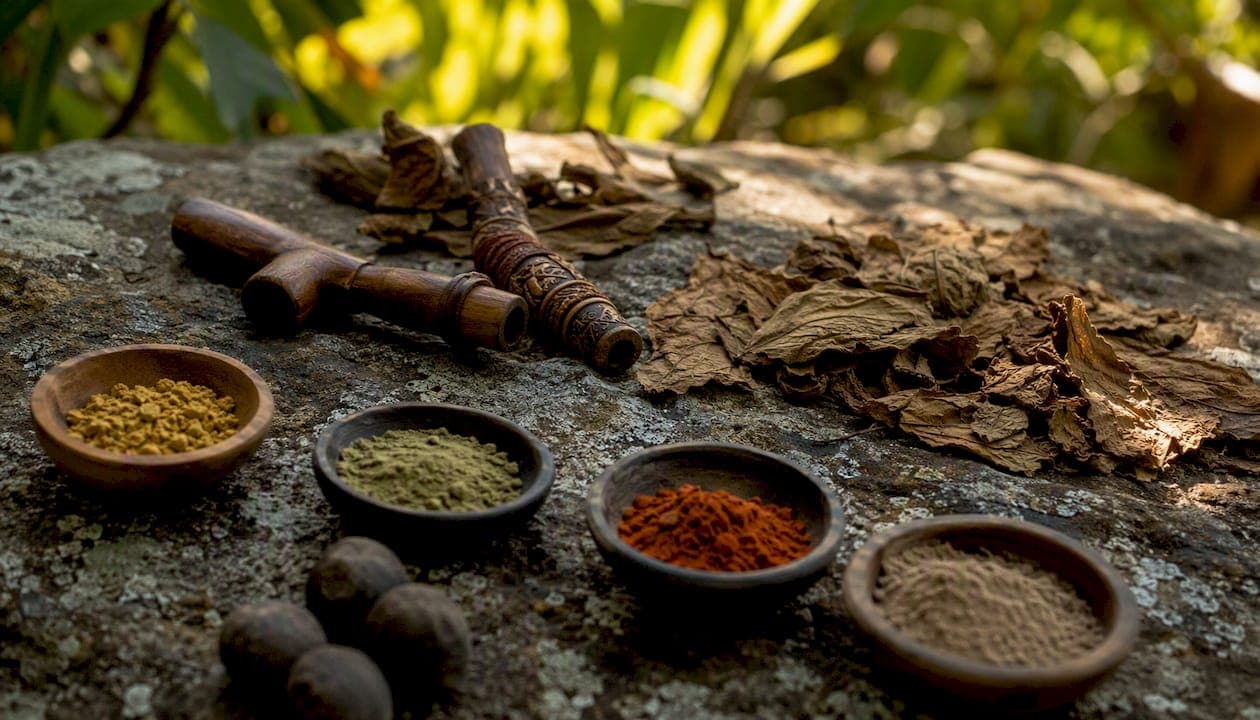
The word "shaman" most plausibly comes from the Manchu-Tungus root šaman, meaning "one who knows," a term rooted in Siberian hunter-gatherer societies and carried into European languages through Russian contact in the seventeenth century. The practices themselves are older and harder to pin down. Shamanic techniques, trance states paired with healing, divination, and communication with spirit worlds, recur across cultures with no shared point of contact, which suggests an ancient behavioral pattern rather than one culture's invention. What scholars debate is how far back that pattern goes.
Here's what current evidence actually supports, and what it doesn't:
- Strongly supported: The Tungusic/Manchu linguistic origin of "shaman," and the practice's recurrence across the majority of documented hunter-gatherer societies studied cross-culturally.
- Contested: Whether Upper Paleolithic cave art and burials dating to roughly 30,000 years before present represent direct evidence of shamanic ritual, or whether that reading imposes a modern category on ambiguous material.
- Weak or fringe: The proposed link between "shaman" and the Sanskrit term śramaṇa, an idea some linguists raise but most reject on phonological grounds.
Pillars of Light hap'e works within Amazonian ceremonial traditions that carry their own distinct history, separate from the Siberian word origin but connected to the same broader human pattern of ritual specialists mediating between ordinary life and something beyond it.
Key Takeaways
Shamanism's word origin traces reliably to a Manchu-Tungus root meaning "one who knows," while the age and geographic origin of the practices it describes remain genuinely debated among archaeologists and anthropologists.
| Point | Details |
|---|---|
| Etymology is well established | "Shaman" derives from the Manchu-Tungus root šaman, tied to the verb ša-, meaning "to know." |
| Sanskrit theory is weak | The proposed link to Sanskrit śramaṇa fails standard phonological tests and lacks scholarly acceptance. |
| Practice recurs across hunter-gatherer societies | Cross-cultural surveys find trance specialists in a large majority of documented hunter-gatherer groups worldwide. |
| Paleolithic evidence is interpretive | Burials and cave art dated to roughly 30,000 years ago suggest possible shamanic elements but remain contested. |
| Historic Siberian evidence is strongest | Shaman burials from the last two millennia match documented ethnographic accounts directly. |
| Multiple theories explain recurrence | Eliade, Winkelman, and cultural-evolutionary models each offer a different, partial explanation for why the role keeps appearing. |
| The term has real limits | "Shaman" is a Siberian word applied globally, and critics warn against flattening distinct traditions under one label. |
| Living traditions continue today | Siberian and Amazonian practitioners carry lineage-based ceremonial knowledge forward, distinct from modern neo-shamanic adaptations. |
Table of Contents
- Where Does the Word "Shaman" Come From?
- What Does the Archaeological Record Show About Shamanism's Age?
- Which Theories Explain Why Shamanism Emerged?
- How Do Shamanic Traditions Differ Across Regions?
- What Do Shamans Actually Do?
- Is "Shaman" the Right Word to Use?
- How Do Shamanic Traditions Survive Today?
- How Do Scholars Actually Study Shamanic Origins?
- What Can We Say for Certain About Shamanism's Origins?
- A Note on How This Article Was Researched
- Where to Read More About Shamanism's Origins
- Frequently Asked Questions
- Sources
Where Does the Word "Shaman" Come From?
The etymology is the most settled part of this entire subject, and it's worth understanding why. The Tungusic and Evenki languages of Siberia use the term šaman or samān to describe a ritual specialist, and linguists trace that noun back to the verb root ša-, meaning "to know." A shaman, in this original sense, is not primarily a healer or a priest. The term names a knower, someone whose authority rests on access to information ordinary people can't reach.
The Manchu-Tungus origin is the version encyclopedic and academic sources treat as strongest, and for good reason: it has clean phonological continuity, a documented geographic source, and a traceable transmission path into European languages.
That transmission path runs through Russia. As Russian traders, soldiers, and administrators pushed into Siberia during the sixteenth and seventeenth centuries, they encountered Tungusic-speaking communities and adopted the local term for the ritual specialists they observed. From there, the word crossed into Western Europe through travel writing. Dutch diplomat Nicolaes Witsen and German physician Adam Brand both published accounts of Siberian life in the late 1600s that introduced European readers to the concept and the word together, cementing "shaman" as the default English and European label for a role that exists, under different names, on nearly every continent.
Not every linguist accepts that this story is the complete picture. A competing proposal ties "shaman" to the Sanskrit term śramaṇa (sometimes rendered śraman), a word for a wandering ascetic or renunciant in early Indian religious traditions. The idea has surface appeal. Buddhist and other South Asian religious movements did spread into Central Asia and parts of Siberia over centuries, and cultural contact between these regions was real.
But the linguistic case is weak. Finnish linguist Juha Janhunen has pointed out that the sound shifts required to get from śramaṇa to šaman don't hold up under standard rules of historical phonology, and no clear chain of intermediate forms documents the transmission. The Tungusic derivation, by contrast, requires no such leap: the word is attested directly in the source languages, among the people practicing the role the word describes.
| Etymology proposal | Source language | Evidence quality | Scholarly acceptance |
|---|---|---|---|
| Manchu-Tungus šaman | Evenki, Manchu (Siberia) | Direct attestation, documented transmission via Russian contact | Widely accepted, treated as standard by encyclopedic sources |
| Sanskrit śramaṇa | Sanskrit (South Asia) | Indirect, requires irregular phonological shifts | Minority view, questioned on linguistic grounds |
| Tocharian/Gandhari intermediary forms | Central Asian trade languages | Speculative, no direct attestation | Fringe, largely unsupported |
A few points worth holding onto if you want to actually understand this debate rather than just repeat a conclusion:
- The Tungusic root is attested in living and historical Siberian languages, not reconstructed from silence.
- The word entered European languages through a documented chain: Siberian contact, Russian adoption, then European travel writing.
- Alternative Sanskrit or Central Asian proposals rely on phonological shortcuts that specialists like Janhunen have directly challenged.
- Etymology tells you where a word came from. It does not, by itself, tell you where the practice the word describes originated. Those are separate questions, and conflating them is one of the most common mistakes in popular writing on this topic.
What Does the Archaeological Record Show About Shamanism's Age?
The oldest material claims for shamanic practice reach back roughly 30,000 years, but "claim" is the operative word. No burial or cave painting comes with a label explaining its ritual purpose, so every archaeological argument for ancient shamanism is an interpretation built on artifact placement, imagery, and comparison with living traditions.
The most frequently cited example is an early Upper Paleolithic burial in Central and Eastern Europe, dated to roughly 30,000 years before present. Some researchers point to unusual grave goods, body positioning, or associated ochre pigment as signs of ritual specialists at work, arguments that carry real weight but stop well short of proof. A grave with distinctive contents shows someone in that society was treated differently in death. It doesn't tell you whether that difference came from a shamanic role as opposed to some other form of status or belief.
| Time period | Approximate date | Location | Evidence type | Strength of shamanic interpretation |
|---|---|---|---|---|
| Early Upper Paleolithic | ~30,000 BP | Central/Eastern Europe | Burial with distinctive grave goods | Interpretive, widely cited but contested |
| Upper Paleolithic cave art | ~17,000 to 11,000 BP | Western Europe (France, Spain) | Cave paintings with therianthropic (part human, part animal) figures | Interpretive, based on comparative ethnography |
| Neolithic period | ~10,000 to 4,000 BP | Multiple regions | Ritual burials, figurines, ceremonial objects | Moderate, supported by contextual patterns |
| Historic Siberian burials | Last 2,000 years | Siberia, Central Asia | Shaman graves with drums, costume elements, tools | Strong, directly linked to documented ethnographic traditions |
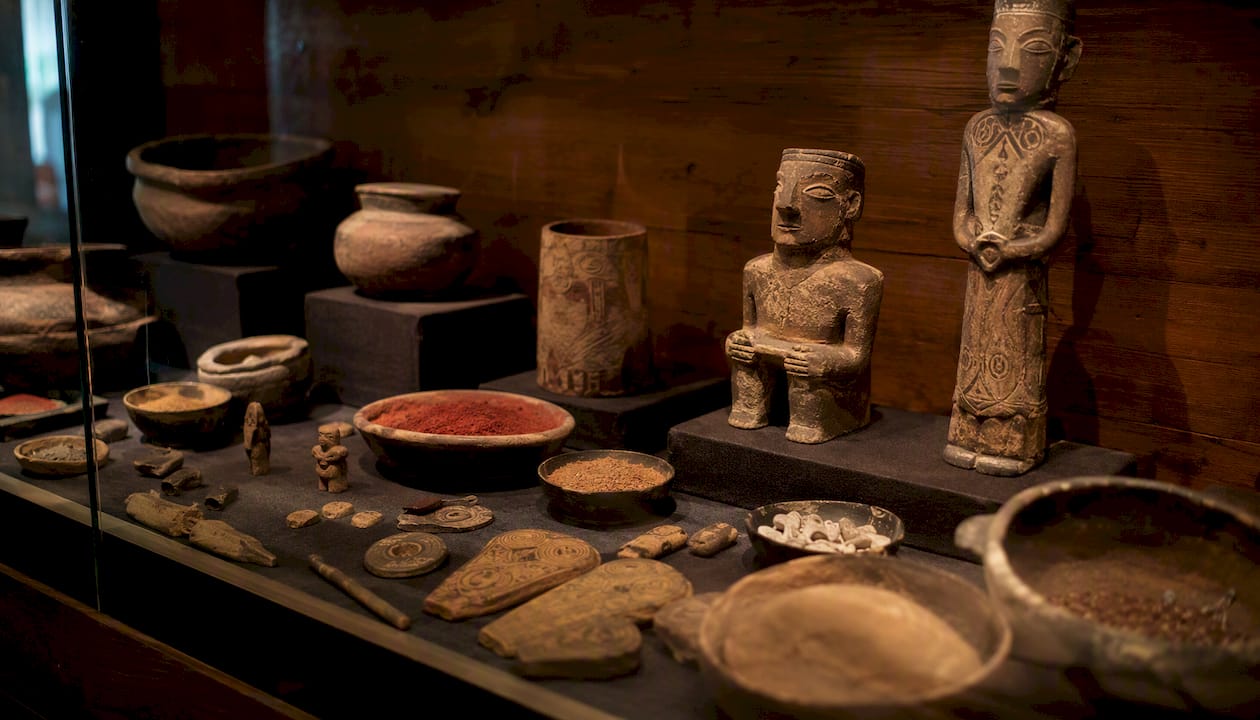
The strongest data point in this entire timeline is also the most recent one. Historic-period Siberian shaman burials, some just a few centuries old, contain drums, costume fragments, and ritual tools that can be matched directly against ethnographic descriptions written by observers who watched living shamans practice. That direct correspondence between object and documented function is exactly what's missing from the Paleolithic material, and it's why archaeologists treat the older claims with far more caution than popular articles usually convey.
Cave art presents its own puzzle. Paintings in sites across France and Spain, dated between roughly 17,000 and 11,000 years before present, include therianthropic figures, images that blend human and animal features. Some researchers read these as depictions of shamans mid-transformation during trance, drawing on ethnographic parallels from cultures where shamans describe taking animal form during spirit journeys. That comparison is suggestive rather than conclusive. Ancient artists could have painted these images for reasons that have nothing to do with a ritual specialist role, and no written record survives to settle the question either way.
That gap between suggestive pattern and confirmed fact is the central methodological problem in this entire field, and it's worth sitting with rather than rushing past.
Which Theories Explain Why Shamanism Emerged?
Three major frameworks dominate the scholarly conversation about why shamanic roles appear so consistently across unrelated societies, and each one answers a slightly different question.
Romanian historian Mircea Eliade built the foundational comparative model in the mid-twentieth century, describing shamanism as a coherent religious phenomenon centered on ecstatic trance and the "journey" to other worlds to retrieve souls, communicate with spirits, or heal the sick. Eliade's work shaped how generations of readers, and more than a few textbooks, understand the category. His critics argue he leaned too heavily on a relatively narrow set of Siberian and Central Asian sources, then projected that specific pattern onto vastly different cultures across the Americas, Africa, and Oceania as if they were all variations on one theme. That's a fair critique. Shamanic practices share family resemblances, not identical structures, and Eliade's synthesis sometimes flattens real differences between traditions.
Anthropologist Michael Winkelman offers a different, more biologically grounded explanation. His neuro-ecological model argues that shamanic trance draws on innate cognitive capacities, ones tied to music, rhythm, dance, and social bonding, that were already present in early human cognition. Rather than treating shamanism as a single invented tradition that spread, Winkelman frames it as a recurring expression of shared human neurobiology, which explains why unconnected societies independently develop strikingly similar trance techniques. His cross-cultural surveys found trance specialists present in a large majority of the hunter-gatherer societies sampled, a pattern that's difficult to explain through cultural diffusion alone given how geographically scattered those societies are.
A third, more recent line of thinking treats shamanism through the lens of cultural evolution: the idea that ritual specialist roles persist because they solve a recurring social problem, offering visible, socially sanctioned responses to uncertainty, illness, and unpredictable misfortune. Under this framing, shamanism isn't a fixed tradition passed down from one origin point. It's closer to a solution that keeps getting reinvented because the underlying problem, human vulnerability to unpredictable harm, never goes away.
Linguist Michael Witzel has approached the question from yet another angle, tracing mythological and cosmological motifs (a layered universe, a world tree, journeys between realms) across Eurasian and circumpolar traditions to argue for deep, ancient connections between belief systems that may predate even the oldest archaeological claims discussed above.
A few things worth remembering about all three models:
- Eliade's phenomenological approach gave the field its vocabulary but is now considered too broad by most working anthropologists.
- Winkelman's neuro-ecological model has empirical backing from cross-cultural surveys, though critics note that "shamanism" as a category still gets applied inconsistently across the studies he draws on.
- Cultural evolutionary explanations account for recurrence without requiring a single point of origin, which fits the archaeological uncertainty better than models that assume one ancient source.
- No single theory fully explains every regional variation. Treat each as a partial lens, not a complete answer.
How Do Shamanic Traditions Differ Across Regions?
Geographic spread is itself evidence. If shamanic roles appeared independently across continents that had no contact with each other for tens of thousands of years, that pattern argues strongly for a recurring human institution rather than a single invention that diffused outward from one place.
Siberia and Central Asia remain the namesake region, and the practices here are the ones most directly documented by outside observers. Tungusic and related traditions center on drum-based trance induction, where rhythmic percussion helps the practitioner enter an altered state to journey to spirit realms on behalf of the community. Costume elements, often incorporating animal parts or metal ornaments meant to represent bones or spirit helpers, mark the shaman visually during ceremony. These are the traditions from which the word itself originates.
The circumpolar North, including Inuit and other Arctic traditions, shares some structural features with Siberian practice, particularly soul-journeying and the belief that illness results from a wandering or captured soul that the practitioner must retrieve. The PBS overview of shamanic traditions documents how widely this soul-retrieval framework recurs across otherwise distinct Arctic and sub-Arctic communities.
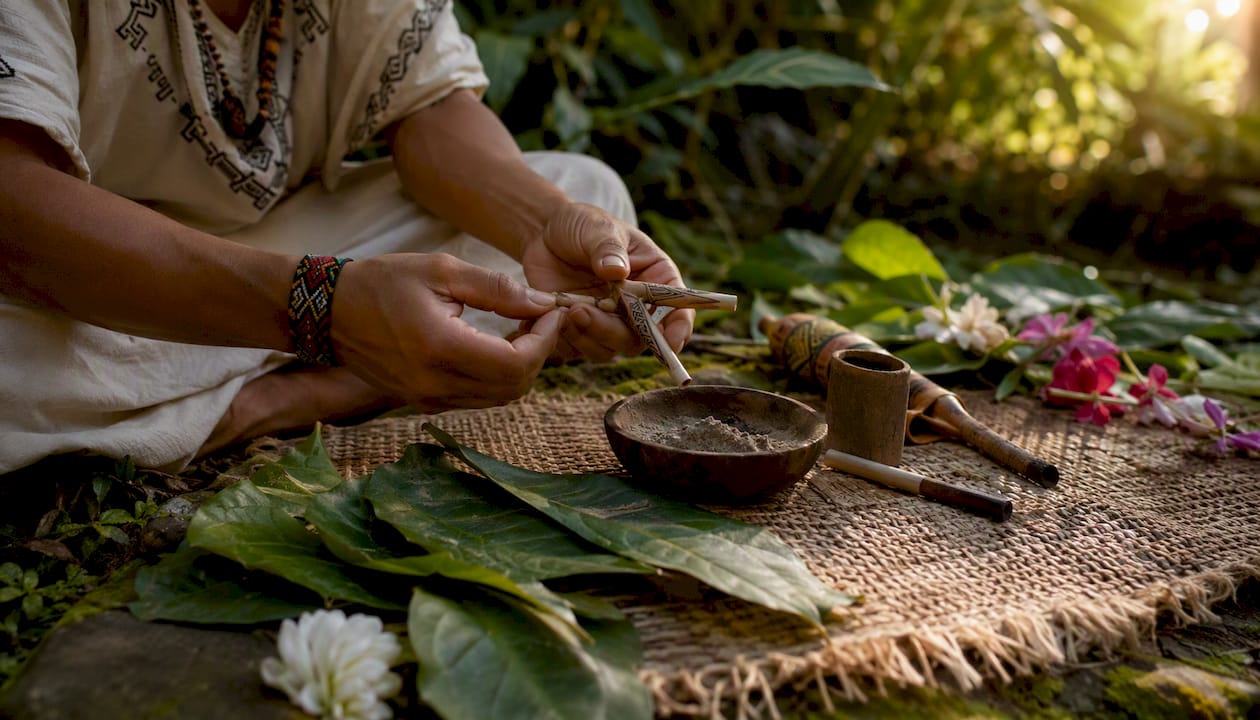
Amazonian traditions represent one of the most distinct and continuously practiced regional expressions, and they're the tradition Pillars of Light hap'e works within most directly. Amazonian shamanic practice frequently incorporates plant sacraments as central ceremonial tools rather than incidental additions. Substances like Hapé, a tobacco-based ceremonial snuff applied through tools like the kuripe and tepi, and broader plant medicine traditions serve roles tied to cleansing, focus, and connection during ceremony. One legal note worth stating plainly: plant sacraments used in Amazonian ceremonial contexts occupy varied legal status depending on the specific substance and jurisdiction, so anyone exploring these traditions should confirm current local law rather than assume blanket legality.
African and Australian/Oceanic traditions show their own distinct specialist roles, divination through bones or objects in parts of Southern Africa, dream-based spirit communication in Aboriginal Australian traditions, that share the underlying pattern of a designated mediator between ordinary and spirit realms without mirroring Siberian practice in any direct sense. These traditions developed independently and deserve to be understood on their own terms rather than measured against a Siberian template.
North American Indigenous traditions vary enormously by nation and region, from Plains vision-quest practices to Northwest Coast spirit dancing, each with distinct cosmologies, initiation processes, and community roles that resist easy generalization.
The through-line across all these regions isn't identical practice. It's a shared human tendency to designate someone whose job is crossing the boundary between the visible and the invisible on behalf of everyone else.
What Do Shamans Actually Do?
Strip away the mystique and shamanic practice breaks into a handful of recurring functional categories, each with its own techniques and its own logic.
Trance induction is the entry point for nearly everything else a shaman does. Drumming, chanting, fasting, sensory deprivation, and in some traditions plant sacraments all serve the same basic function: shifting consciousness into a state where the practitioner reports perceiving spirits, traveling to other realms, or receiving information unavailable in ordinary awareness. Siberian drum-based trance and Amazonian plant-assisted ceremony represent two very different techniques aimed at a structurally similar outcome.
Healing frequently follows from trance work. Many traditions frame illness as the result of a lost soul, an intrusive spirit, or a broken relationship with the natural or spirit world, and the shaman's job is diagnosing which of these applies and correcting it. Soul retrieval, the belief that part of a sick person's spirit has wandered or been taken and must be brought back, appears independently in Siberian, circumpolar, and some South American traditions.
Divination covers a separate but related function: using altered states, objects, or ritual observation to answer specific questions, locate game animals, identify the cause of misfortune, or forecast events that matter to the community.
Initiation marks entry into the role itself, and it's rarely casual. Many traditions require candidates to survive a symbolic death and rebirth, a period of illness, isolation, or ordeal interpreted as proof the spirits have chosen and tested the person before granting them the role.
Material culture reinforces all of this. Drums and rattles support trance induction across Siberian and circumpolar traditions. Spirit costumes visually mark the practitioner's altered status during ceremony. In Amazonian contexts, tools like the kuripe and tepi serve a specific ceremonial function, applying plant medicine as part of structured ritual rather than as a standalone product.
Pro Tip: When you read an ethnographic account of a shamanic ceremony, pay close attention to whether the writer is describing what they directly observed or interpreting what a practice "means." Direct description (what was said, done, and used) tends to hold up well over time. Interpretive claims about symbolism or belief are far more likely to reflect the observer's own assumptions, so treat those passages with a healthier degree of skepticism.
It's worth resisting the temptation to assume every trance state or every ritual object you encounter maps cleanly onto a single global definition of "shamanism." The category is useful as a comparative tool. It's a poor substitute for understanding any one tradition on its own terms.
Is "Shaman" the Right Word to Use?
Plenty of anthropologists argue it isn't, or at least not without real qualification, and their reasoning deserves more attention than it usually gets in casual writing on this subject.
The core critique is that "shaman" is a Siberian, Tungusic term that got exported by nineteenth and twentieth century European scholars and applied to ritual specialists across Africa, the Americas, and Oceania who never used anything resembling that word and whose traditions developed with no contact with Siberia at all. Critics call this analytic overreach: taking one culture's specific vocabulary and stretching it into a universal category, which risks erasing the real differences between, say, a Siberian drum-trance specialist and an Amazonian plant-medicine facilitator.
There's also a sharper, more contemporary version of this critique focused on the "plastic shaman" phenomenon, individuals with no lineage, training, or community accountability who adopt the title commercially, often profiting from ceremonies stripped of their original cultural and social context. This is where scholarly critique and ethical concern overlap directly, and it's a genuine problem in how plant medicine and ceremonial traditions get marketed to outsiders.
"Shamanism" as an analytic category was built by outside observers describing a role that already existed inside specific, unrelated cultures long before anyone applied that label to it. The word is a scholarly convenience. The traditions it points to are not interchangeable, and treating them as such flattens real cultural distinctions that matter enormously to the communities who hold them.
Responsible use of the term means a few concrete things:
- Name the specific tradition (Siberian, Amazonian, circumpolar) rather than defaulting to the generic label whenever precision matters.
- Credit the communities and lineages a practice comes from rather than presenting shamanic knowledge as a free-floating universal resource.
- Treat living practitioners, and the traditions found in resources on the role of Indigenous elders in medicine, as authorities on their own practices rather than subjects for outside reinterpretation.
- Be skeptical of anyone claiming shamanic authority without a traceable connection to a specific lineage or community.
How Do Shamanic Traditions Survive Today?
Living, lineage-based shamanic traditions haven't disappeared. Siberian communities and Amazonian practitioners continue ceremonial work passed down through direct apprenticeship, often stretching back through generations of family or community teaching. That continuity matters because it's the clearest counterargument to any narrative that treats shamanism as a relic confined to the ancient past.
Syncretism runs alongside that continuity. In many parts of Latin America, shamanic practice has blended with Catholic imagery and ritual structure over centuries of contact, producing hybrid traditions that are neither purely Indigenous nor purely Christian but something genuinely new. Similar blending shows up wherever colonization, migration, and religious contact pushed distinct traditions into sustained proximity.
Neo-shamanism, a modern Western movement that borrows shamanic vocabulary and techniques, largely detached from any single lineage, is a separate phenomenon and a more complicated one. Some neo-shamanic practitioners approach the work with genuine study and humility. Others fall into exactly the "plastic shaman" pattern described above, charging for ceremonies built on borrowed aesthetics rather than earned knowledge. The difference between the two usually comes down to a few concrete, checkable things.
If you're considering working with a practitioner or exploring a tradition as an outsider, a short ethics checklist is worth keeping in mind:
- Provenance: Can the practitioner name their specific lineage, teacher, or community of training?
- Community consent: Does the community the tradition comes from support how this knowledge is being shared or sold?
- Credentials that mean something locally: Formal Western certifications mean little here. What matters is recognition within the tradition itself.
- Safety with plant medicines: Any facilitator working with plant sacraments should be transparent about sourcing, preparation, and contraindications.
One legal caveat worth stating directly: plant medicines used in ceremonial contexts carry varying legal status depending on the specific substance and where you live, and this article isn't a substitute for checking current local law before pursuing any ceremonial practice involving plant sacraments. Resources like Amazonian healing traditions explained for curious minds and indigenous plant medicine traditions can help you build the cultural context before you go looking for a practitioner.
How Do Scholars Actually Study Shamanic Origins?
Origin claims in this field rest on three main pillars of evidence, and the strongest claims are the ones where all three line up.
Linguistics traces word origins and cognates across language families, the same method that establishes the Tungusic root of "shaman" with real confidence. Archaeology examines burials, artifacts, and imagery for patterns that might indicate ritual specialization, though as covered earlier, this evidence is almost always interpretive rather than direct. Ethnography documents living or recently living traditions in detail, providing the closest thing to direct observation available, and it's the method that makes historic Siberian shaman burials so much more convincing than Paleolithic ones: ethnographers actually watched and recorded what those later practitioners did.
Cross-cultural comparative databases like eHRAF World Cultures let researchers systematically compare ethnographic and archaeological records across hundreds of societies, which is how claims about recurrence (shamanic roles appearing in a large majority of sampled hunter-gatherer societies) get tested rather than asserted.
The pitfalls are just as important to understand as the methods themselves:
- Circular reasoning from modern ethnography: using a living tradition's practices to interpret an ancient artifact, then citing that interpretation as independent evidence for how old the tradition is.
- Overreading imagery: treating any ambiguous or animal-human figure in ancient art as automatic proof of shamanic belief, when simpler explanations often fit the evidence just as well.
- Projecting modern categories backward: assuming a Paleolithic society organized ritual roles the same way a documented nineteenth-century Siberian community did, without any direct evidence that continuity exists.
A useful example of methods reinforcing each other: the direct match between historic Siberian shaman grave goods and documented ethnographic descriptions of shaman costume and tools represents genuine cross-disciplinary corroboration, archaeology and ethnography confirming the same picture independently. A useful example of the opposite: Upper Paleolithic cave art motifs read as "shamanic" have no comparable ethnographic anchor from the period itself, which is exactly why that interpretation remains contested rather than settled.
What Can We Say for Certain About Shamanism's Origins?
The etymology holds up. "Shaman" traces cleanly to the Manchu-Tungus root šaman, "one who knows," and the word's path into European languages through Russian contact and early travel writing is well documented at every step. That part of the story is about as settled as historical linguistics gets.
The practice itself is a different matter. Shamanic techniques recur across cultures with no shared contact, which points to something ancient and recurring in human social organization rather than a single invention that spread outward from one point. But exactly how old that pattern is remains genuinely open. The strongest evidence sits in the historic period, where Siberian shaman burials match documented ethnographic accounts almost artifact for artifact. The weakest, most contested evidence sits at the far end of the timeline, in Upper Paleolithic burials and cave art roughly 30,000 years old, where interpretation does most of the work that direct evidence can't.
If there's one open question worth carrying forward, it's this: does the deep time depth some scholars claim actually hold up, or does it reflect modern researchers reading a familiar pattern into ambiguous ancient material? The honest answer, right now, is that nobody knows for certain. For readers who want to go further, the sources listed at the end of this article are a solid next stop, particularly the archaeological literature on Paleolithic cave art and the cross-cultural surveys that quantify just how widespread shamanic roles really are.
A Note on How This Article Was Researched
Manifest Light approached this subject the way any serious cross-cultural topic deserves: prioritizing primary linguistic sources, peer-reviewed archaeological literature, and cross-cultural anthropological surveys over popular summaries that tend to blur etymology and practice together as if they were the same question.
That distinction matters more than it might seem. A huge amount of casual writing on shamanism treats "the word comes from Siberia" and "the practice is 30,000 years old" as though they're the same claim, verified by the same evidence. They aren't, and conflating them is one of the fastest ways to overstate what's actually known.
It's also worth being direct about limits. This article draws on scholarly sources and cross-cultural comparison, but it makes no claim to speak for any living shamanic tradition or to represent the authority of practitioners within those lineages. Amazonian ceremonial knowledge in particular belongs to the communities who hold and transmit it, and nothing here should be read as a substitute for that lineage-based authority.
Where to Read More About Shamanism's Origins
- Britannica: Shamanism, for the standard encyclopedic account of the term's Manchu-Tungus origin.
- Cross-cultural and anthropological review of shamanism, covering Winkelman's cross-cultural survey data on hunter-gatherer societies.
- Shamanic referents in Upper Palaeolithic cave art, the key archaeological literature on Paleolithic-era interpretive claims.
- PMC article on the evolution of shamanic and healing practices, linking shamanic roles to ancient medical and ritual systems.
- eHRAF World Cultures, Yale's cross-cultural ethnographic and archaeological database.
- Cross-Culturally Exploring the Concept of Shamanism, on the distinction between local Tungusic terms and the global analytic category.
- Harvard Gazette: shamans as an early professional class, on professionalization within shamanic roles.
- Shamanism entry, Wikipedia, for background on the word's adoption into European languages.
- PBS: Shamanism (The Split Horn), for accessible regional examples across Siberia, the Americas, and beyond.
- Taking Charge (University of Minnesota): Shamanism overview, for a plain-language summary of core shamanic functions.
Frequently Asked Questions
Where did shamanism originate from? The word "shaman" originated among Tungusic-speaking peoples in Siberia. The practices the word describes appear to have emerged independently and repeatedly across unrelated hunter-gatherer societies worldwide, rather than spreading outward from one single point of origin.
What does the word "shaman" actually mean? It comes from the Manchu-Tungus root ša-, "to know," making a shaman literally "one who knows." The term describes a specialist whose authority comes from privileged access to spiritual or hidden knowledge.
How old is shamanism? That depends on whether you mean the word or the practice. The word is a few centuries old in European usage. The underlying practices may reach back tens of thousands of years, though the oldest archaeological claims, tied to roughly 30,000-year-old burials, remain interpretive rather than confirmed.
Is shamanism a religion? Most scholars treat it as a set of ritual techniques and a social role rather than an organized religion with fixed doctrine. It appears within many religious systems worldwide, sometimes standing alone and sometimes blended with other belief structures through syncretism.
Why do some scholars object to the term "shamanism"? Because it's a Siberian, Tungusic word that got applied globally to traditions with no historical connection to Siberia, which risks erasing real cultural differences between distinct practices in the Amazon, Africa, North America, and Oceania.
Are Amazonian ceremonial traditions the same as Siberian shamanism? No. They share a broad family resemblance, trance, healing, and spirit communication, but developed independently with distinct tools, cosmologies, and ceremonial practices. Amazonian traditions have their own specific history, separate from the Siberian origin of the word itself.
Sources
- Cross‑cultural and anthropological review of shamanism (Winkelman / review)
- PMC article on the evolution of shamanic and healing practices