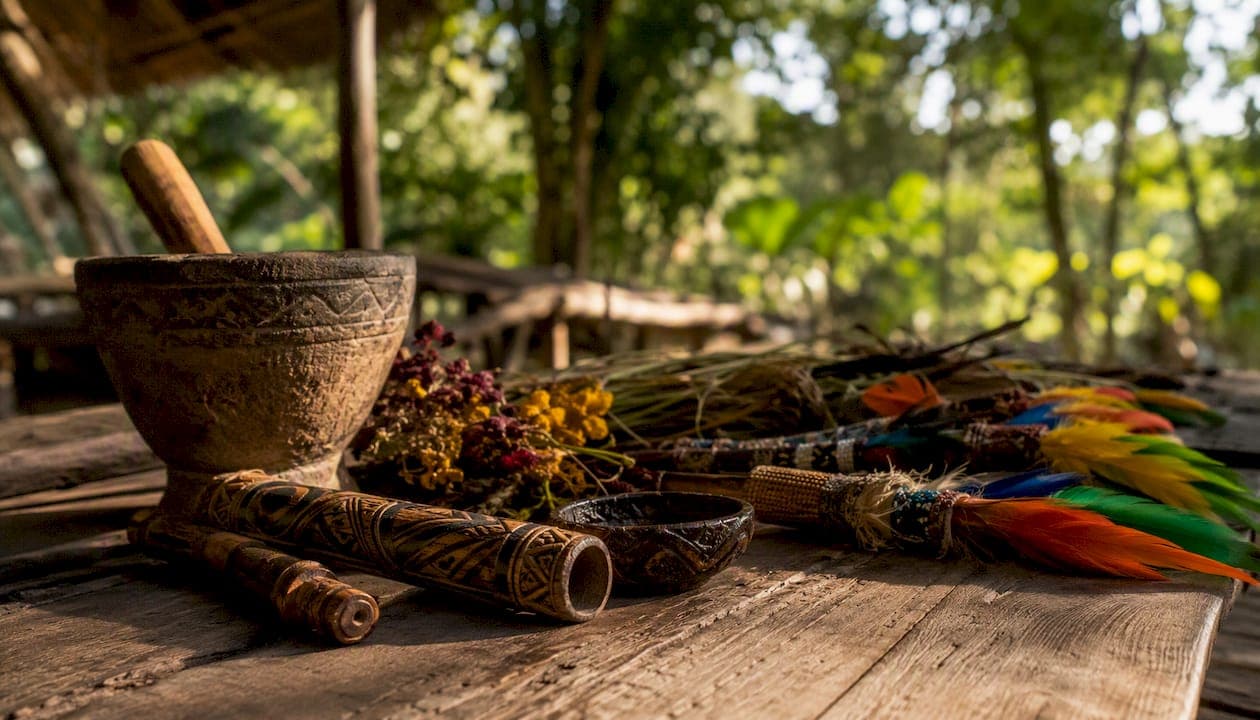
Amazonian tools for indigenous ceremony are the handcrafted instruments, vessels, and applicators that structure ritual action, carry plant medicines to the body, and mark the roles of healers, participants, and spirit allies within ceremony. They are not decorative objects. Each one holds a specific function, a lineage of craft knowledge, and a cultural meaning that belongs to the community that made it.
Before going further, three things every U.S. reader should know:
- Snuff applicators and rattles (kuripê, tepí, maracas) are the most commonly encountered tools in North American ceremonial contexts.
- Botanical ceremonial items like mortars, pestles, and drinking vessels are preparation tools as much as ritual objects.
- Legal status varies: non-psychoactive tools are generally legal to own in the U.S., but certain plant medicines used with them (ayahuasca, yopo) involve controlled substances under federal law. Medical risks are real, and screening matters.
The sections below walk through the full catalog of tools, their connections to specific plant medicines, the symbolism encoded in their design, how to engage respectfully, and how to source ethically in the United States.
Table of Contents
- What are the main Amazonian tools used in indigenous ceremony?
- How plant medicines and ceremonial tools work together
- What do the symbols and regional styles on ceremonial tools mean?
- How to engage with Amazonian ceremonies and tools respectfully
- What U.S. readers need to know about safety and legality
- How to ethically source ceremonial tools in the United States
- Key Takeaways
- Why stewardship matters more than ownership
- Pillars of Light hap'e: ethically sourced tools, shipped from Texas
- Useful sources for further study
What are the main Amazonian tools used in indigenous ceremony?
The catalog of Amazonian ceremonial tools spans snuff applicators, percussion instruments, wind instruments, preparation vessels, and regalia. Each category has a distinct ceremonial role, and most are made from materials gathered within the communities that use them.
Hapé (rapé) blends
Hapé, also spelled rapé, is a finely ground sacred snuff made from tobacco and other botanical ingredients. It is not smoked. It is blown directly into the nostrils using an applicator. The blend itself is the medicine; the applicator is the delivery instrument. Different tribal lineages produce distinct blends with varying botanical compositions, and the preparation process is itself ceremonial.
Kuripê (self-applicator)
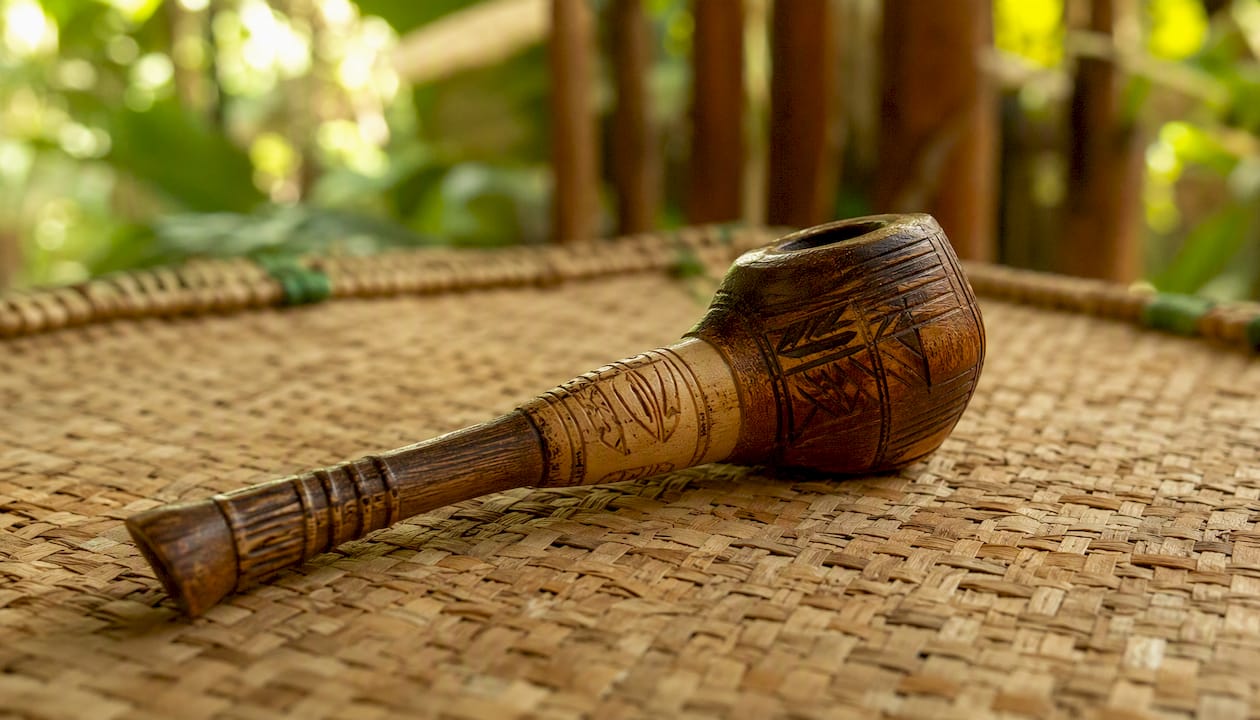
The kuripê is a V-shaped or curved pipe, typically carved from bone, bamboo, or hardwood, that allows a person to self-administer hapé by placing one end in the nostril and blowing through the other. It is the standard tool for solo or personal practice. Handcrafted kuripês often carry carved motifs specific to the artisan's tribal tradition. You can explore handcrafted wooden kuripês made by Amazonian artisans to see what authentic construction looks like.
Tepí (facilitator applicator)
The tepí is a longer, straight blow pipe used when one person administers hapé to another. It requires a trained facilitator. The length creates distance between the blower and recipient, and the facilitator's breath carries both the medicine and intentional energy into the ceremony. Shipibo-made tepís, for example, often feature kené-style geometric linework burned or carved into the shaft. The Jaguar Tepí from the Shipibo Collection is one example of a tribally attributed piece with documented origin.
Yopo inhalers
Yopo (Anadenanthera peregrina) is a visionary snuff prepared from the seeds of a tree native to the Orinoco basin and parts of the Amazon. Two primary inhaler forms are documented in the Upper Orinoco region: a Y-shaped inhaler placed in both nostrils simultaneously for individual use, and a long thin tube through which a partner blows the powder. The Yanomami typically use the long tube; the Hiwi, Yabarana, and Piaroa more commonly use the Y-shaped form. The choice of inhaler is a cultural variable, not a technical preference.
Wooden mortars and pestles
Yopo seeds are toasted, ground, and mixed with alkaline ash using wooden mortars and pestles before inhalation. The same tools appear in hapé preparation, where tobacco and botanicals are ground to a fine powder. The mortar and pestle set is a preparation tool, not a ceremonial centerpiece, but its use is governed by ritual protocol. The Museo de América's yopo set documentation also records shell containers, combs, and feathers used to clean inhalers between uses.
Maracas and rattles
Maracas and calabash-based rattles function as both musical and spiritual interfaces in Amazonian ceremony. They punctuate icaros (healing songs), demarcate ritual space, and synchronize group intention. The acoustic properties depend on gourd wall thickness, the size and number of seed fillings, and handle balance. Artisans tune rattles by selecting specific seeds and thinning the shell during drying. The Yekuana madaka rattle, documented in the Hartenberger World Musical Instrument Collection, is made from a single calabash with a carved heartwood handle, filled with pebbles and medicinal plant roots, and decorated with feather attachments and geometric designs.
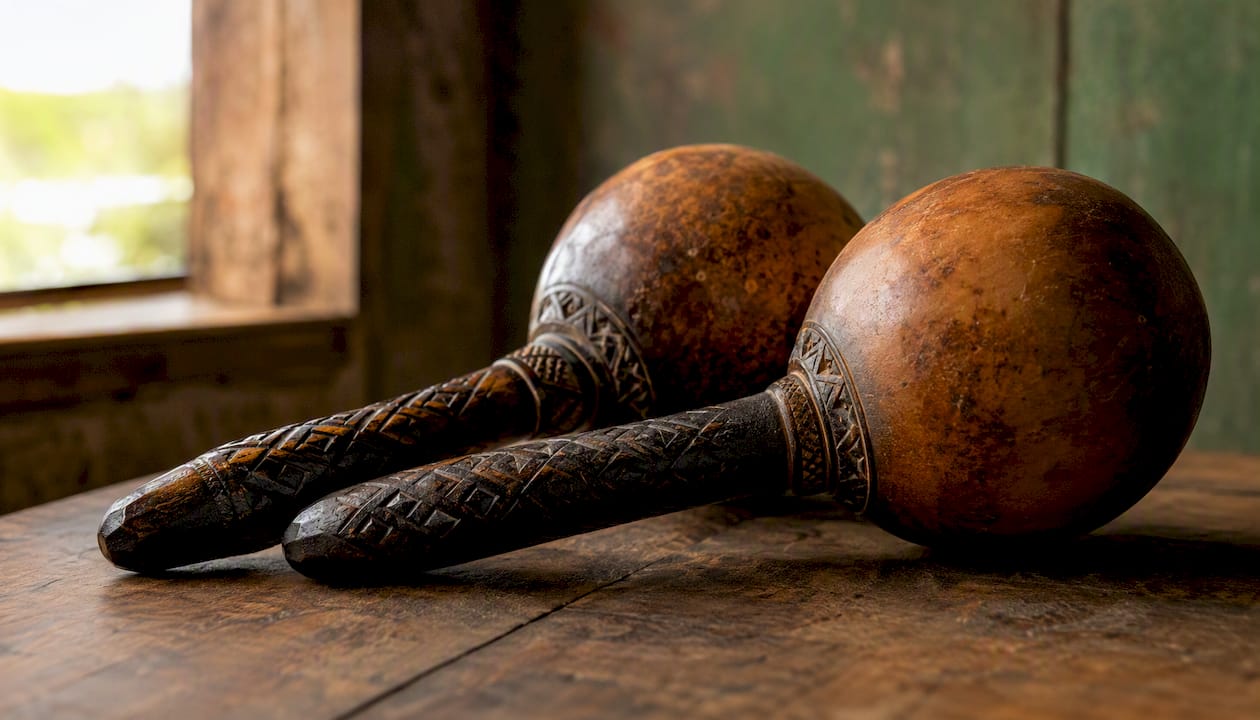
Pro Tip: When evaluating a rattle's authenticity, shake it and listen. A mass-produced tourist rattle typically has a uniform, plastic-sounding rattle from synthetic beads. A hand-tuned ceremonial rattle produces a layered, organic sound with variation across the shake.
Vertical flutes and panpipes
Wind instruments carry a different energy than percussion in ceremony. Vertical flutes made from bamboo or bone produce tones used to call spirits, open ceremonial space, or accompany healing songs. Panpipes appear in communal ceremonies across the Andes-Amazon interface. Like rattles, they are energetic interfaces that structure time within the ritual and guide participants' attention.
Drums
Drums ground ceremony in rhythm and are used in some Amazonian traditions to open or close ritual space, though they are less central in many lowland Amazonian ceremonies than in Andean or North American traditions. Where they appear, frame drums or log drums made from local hardwoods serve as anchors for collective intention.
Feather headdresses and adornments
Feather headdresses, armbands, and body adornments are worn by facilitators and participants to signal ceremonial roles and invoke the qualities of specific animals. Harpy eagle feathers, macaw feathers, and toucan beaks each carry distinct symbolic weight. These are not costumes. They encode clan identity and cosmological relationships, and wearing them without lineage or permission is a serious cultural transgression.
Ceremonial benches
Low wooden stools or benches are used by healers and participants during ceremony, particularly in ayahuasca and tobacco ceremonies. The Smithsonian National Museum of the American Indian documents Tukano ceremonial stools as specialized objects produced and traded along river networks, reflecting both craft skill and intercommunity exchange. Sitting on the earth or on a low bench keeps the body grounded during altered states.
Drinking horns and serving vessels
Ayahuasca and other plant-based brews are served in specific vessels, often carved wooden cups or dried gourd bowls. The vessel is part of the ceremony. Some lineages consecrate serving cups through smoke, song, or plant baths before use. A plastic cup at an ayahuasca ceremony is a red flag, not a minor detail.
How plant medicines and ceremonial tools work together
The relationship between tools and medicines is not incidental. Each medicine has a specific set of tools that govern its preparation, administration, and ceremonial container.
Hapé with kuripê and tepí
Hapé preparation begins with the grinding of tobacco and botanical ingredients into a fine powder, often using a mortar and pestle. The blend is then stored in a small sealed container, traditionally made from bamboo or bone, until use. In ceremony, a facilitator loads the tepí and blows the medicine into the recipient's nostrils with a single, intentional breath. For solo practice, the kuripê serves the same function. The full tradition behind hapé covers lineage-specific preparation methods and safe-use guidance in detail.
Administration steps for hapé in ceremony:
- Set intention and ask permission from the medicine and the facilitator.
- The facilitator loads the tepí with the appropriate dose.
- The recipient tilts the head slightly and receives the medicine in the left nostril first (in most traditions), then the right.
- Sit quietly, breathe through the mouth, and allow the medicine to work.
- Do not blow the nose immediately. Allow the process to complete.
Yopo with inhalers and mortars
Yopo preparation is more involved. Seeds are toasted over low heat, shelled, and ground in a wooden mortar with alkaline ash (typically from snail shells or tree bark) to activate the active compounds. The resulting powder is then administered using the inhaler appropriate to the tradition. The preparation itself is ceremonial, and the mortar and pestle are treated with respect throughout.
What do the symbols and regional styles on ceremonial tools mean?
Ornamentation on Amazonian ceremonial tools is not decoration. It is a communication system. Clan identity, cosmological relationships, and the tool's spiritual function are encoded in geometric patterns, animal motifs, and material choices.
Common symbolic motifs
Shipibo-Conibo artisans are known for kené, a complex geometric linework that maps the body of the cosmic anaconda and encodes healing songs visually. The same patterns appear on textiles, ceramics, and ceremonial tools including maracas, benches, and tepís. Jaguar imagery signals shamanic power and the capacity to move between worlds. Serpent motifs often represent the ayahuasca vine itself or the flow of healing energy. Bird imagery, particularly condor and harpy eagle, signals connection to upper-world spirit agencies.
Ornamentation often encodes clan identity and cosmological information rather than serving as mere decoration. A tool's markings tell you who made it, what lineage it belongs to, and what it is for.
Regional variation
| Tool Category | Representative Tribes/Regions | Museum Collection Reference |
|---|---|---|
| Y-shaped yopo inhaler | Hiwi, Yabarana, Piaroa (Upper Orinoco) | Museo de América, Madrid |
| Long-tube yopo inhaler | Yanomami (Venezuela/Brazil border) | Museo de América, Madrid |
| Kené-decorated tepí | Shipibo-Conibo (Ucayali River, Peru) | Smithsonian NMAI |
| Madaka rattle | Yekuana (Venezuela/Brazil) | Hartenberger World Musical Instrument Collection |
| Ceremonial stool | Tukano (Northwest Amazon) | Smithsonian NMAI |
| Feather headdress | Multiple Amazonian groups | Smithsonian NMAI |
The Smithsonian National Museum of the American Indian's Amazon exhibition documents trade networks that carried ceremonial objects across river systems, meaning a tool's style may reflect both its maker's tradition and the exchange relationships of the community. Asháninka textiles and Tukano stools are examples of objects that traveled far from their origin communities through these networks.
Historical fieldwork by ethnobotanist Richard Evans Schultes, archived at Harvard's Peabody Museum, provides mid-20th-century documentation of tool use and plant preparation across the Amazon basin, offering a baseline for understanding how practices have evolved and what has remained consistent.
How to engage with Amazonian ceremonies and tools respectfully
Respectful engagement starts before you enter a ceremony space and continues after you leave. These are not abstract principles. They are practical behaviors.
Before ceremony
- Research the facilitator's lineage and training. Ask directly: "Who trained you, and for how long?"
- Confirm that the ceremony is community-led or has documented permission from an indigenous community.
- Disclose your full medical history to the facilitator, including all medications and supplements.
- Ask whether the tools used in the ceremony were sourced with community consent and fair compensation.
- Read the ceremony etiquette guide published by Pillars of Light hap'e before attending.
During ceremony
- Follow the facilitator's instructions without negotiation. Ceremony protocol exists for reasons that may not be immediately apparent.
- Do not touch tools, altars, or other participants without explicit permission.
- Silence phones and remove watches. Time-keeping disrupts ceremonial space.
- If you feel unsafe, communicate with the facilitator or a designated helper. Do not leave the space alone.
After ceremony
- Integration matters. Allow time before returning to normal activity.
- Do not share photographs of ceremony spaces, altars, or participants without consent.
- Acknowledge the tradition publicly when discussing your experience.
Cultural appropriation vs. cultural exchange
The line between appropriation and exchange is consent and benefit. Cultural exchange happens when indigenous communities lead, set terms, and receive fair compensation. Appropriation happens when outsiders extract practices, objects, or aesthetics without permission, attribution, or reciprocity. Buying a mass-produced "shaman kit" from an anonymous online seller with no provenance is appropriation. Purchasing a handcrafted tool directly from an artisan cooperative with documented community benefit is exchange.
Contemporary indigenous organizations describe ceremony as a core social practice tied to land defense and cultural survival. Participating in or supporting these traditions carries a responsibility to protect them.
What U.S. readers need to know about safety and legality
Legal status of tools and medicines
Non-psychoactive ceremonial tools, including kuripês, tepís, rattles, flutes, drums, and feather adornments, are generally legal to own and use in the United States. The tools themselves are not controlled substances.
The medicines are a different matter:
- Hapé/rapé: — contains tobacco (Nicotiana rustica), which is legal. Some blends include other botanicals; legality depends on specific ingredients.
Pro Tip: Federal law governs controlled substance status, but state laws vary. Oregon, Colorado, and California have enacted or are enacting reforms around certain psychedelic substances. Always verify current state law through your state's official legislative website or consult a licensed attorney before participating in any ceremony involving controlled substances.
Medical screening
Responsible facilitators screen participants before ceremony. If a facilitator does not ask about your medications, medical history, or mental health background, that is a serious red flag. Minimum screening should cover:
- Current medications (especially SSRIs, MAOIs, blood thinners, heart medications)
- History of psychosis, schizophrenia, or bipolar disorder
- Cardiovascular conditions
- Pregnancy or breastfeeding status
This article is general educational information, not medical or legal advice. Verify current laws with a qualified attorney and consult a licensed healthcare provider before participating in any plant-medicine ceremony.
How to ethically source ceremonial tools in the United States
Ethical sourcing means knowing who made the tool, where the materials came from, and whether the community that produced it was fairly compensated. These are verifiable facts, not marketing claims.
Questions to ask sellers
- "Who made this, and can you tell me about them?"
- "How was the wood/gourd/bone harvested, and by whom?"
- "Does your sourcing process involve direct relationships with indigenous communities?"
- "Is there documentation I can review?"
Red flags
- Vague origin claims ("handmade in South America" with no further detail)
- Mass-produced imitations with uniform finishes and no variation between pieces
- Prices far below what fair-wage artisan work would cost
- No response to provenance questions
- Tools described as "authentic" without any supporting documentation
Understanding why wild-harvested herbs and botanicals carry distinct properties also applies to the plant materials used in ceremonial tool construction. Seasonal harvest, community protocol, and material selection are not incidental details.
At Pillars of Light hap'e, provenance documentation is part of the sourcing process, not an afterthought. The store carries tools with documented tribal attribution, and the team can provide sourcing information on request. Readers who want to verify the origin of a specific piece before purchasing are encouraged to reach out directly through the website.
For more on sustainable harvest practices and what buyers should understand about the relationship between sourcing and rainforest health, the Pillars of Light hap'e blog covers rainforest preservation and plant medicine in practical terms.
Key Takeaways
Amazonian ceremonial tools carry specific ritual functions, cultural lineages, and ethical responsibilities that every U.S. buyer or ceremony participant should understand before engaging.
| Point | Details |
|---|---|
| Tools have specific ritual roles | Each instrument, applicator, or vessel serves a defined function in ceremony, not a decorative one. |
| Medicine and tool are paired | Hapé uses kuripê or tepí; yopo uses inhalers and mortars; ayahuasca uses consecrated vessels and sound tools. |
| Legality varies by substance | Non-psychoactive tools are generally legal in the U.S.; ayahuasca and yopo involve Schedule I compounds under federal law. |
| Provenance is verifiable | Ethical sourcing means documented artisan origin, tribal attribution, and community benefit, not vague "handmade" claims. |
| Pillars of Light hap'e | Offers ethically sourced kuripês, tepís, and ceremonial items with documented tribal attribution and provenance available on request. |
Why stewardship matters more than ownership
The conversation around Amazonian ceremonial tools in the United States tends to focus on acquisition. Which tools are authentic? Where can you buy them? What do they do? Those are reasonable questions, and this article answers them. But the more important question is rarely asked: what does it mean to hold one of these objects responsibly?
These tools were not made to be collected. They were made to be used within a living ceremonial tradition, by people trained in that tradition, in service of a community. When a kuripê or a rattle travels from an Amazonian village to a shelf in California or Oregon, something is gained and something is at risk. What is gained is access. What is at risk is context.
The communities that produce these tools are not artifacts of the past. They are actively defending their land, their ceremonies, and their right to practice in the face of real pressures. Buying a tool from a supply chain that bypasses those communities does not support tradition. It extracts from it.
The most respectful posture for a U.S. reader is not passive appreciation. It is active accountability: asking hard questions about provenance, paying prices that reflect fair artisan wages, and supporting organizations that work directly with indigenous communities. A tool held with that kind of intention carries something real. One purchased without it is just an object.
Pillars of Light hap'e: ethically sourced tools, shipped from Texas
For readers ready to move from learning to acquiring, Pillars of Light hap'e offers something specific: ceremonial tools with documented tribal attribution, sourced through direct relationships with Amazonian artisan communities, and shipped from Old Town Spring, Texas.
The ceremonial items collection includes handcrafted kuripês, tepís, rattles, and related Amazonian botanical ceremonial items, each with sourcing information available on request. The store carries 75+ varieties of hapé alongside the applicators and tools that serve them. For readers in California, Oregon, or anywhere in the U.S. who want to ethically purchase Amazonian ceremonial tools without navigating overseas vendors or unverifiable supply chains, Pillars of Light hap'e is a direct, provenance-backed option. Browse the kuripê and tepí collection or reach out through the website to request documentation on a specific piece before you buy.
Useful sources for further study
The sources below are the primary references used in this article. Each one is worth exploring directly for deeper study.
| Source | What It Documents | Why It Matters |
|---|---|---|
| Museo de América — Yopo Set | Y-shaped and long-tube inhalers, preparation tools, shell containers | Museum-documented yopo inhaler forms and associated tool sets from the Upper Orinoco |
| Smithsonian NMAI — Amazon Exhibition | Ceremonial stools, textiles, trade networks, regional styles | Authoritative ethnographic documentation of Amazonian material culture and provenance |
| Hartenberger Collection — Yekuana Madaka | Madaka rattle construction, materials, ornamentation | Concrete construction details for a documented sacred rattle with tribal attribution |
| Harvard Peabody Museum — Richard Evans Schultes | Mid-20th-century ethnobotanical fieldwork, plant and tool documentation | Primary archival documentation of Amazonian ceremonial plant use and tool sets |
| Sacred Tools and Instruments — Yaogara | Instrument function, calabash construction, energetic roles in ceremony | Practitioner-informed overview of how instruments function as spiritual interfaces |
| Amazon Frontlines — Ceremony | Ceremony as social practice, land defense, community continuity | Indigenous organizational perspective on the living role of ceremony today |
| Ayahuasca — Wikipedia | Botanical composition of ayahuasca, general ethnobotanical background | Accessible high-level overview; best used alongside primary ethnographic sources |
For primary ethnographies, the works of Luis Eduardo Luna, Glenn Shepard Jr., and Bernd Brabec de Mori offer peer-reviewed depth on Amazonian ceremonial practice that goes well beyond what any single article can cover. Museum catalogs from the Smithsonian, the Musée du quai Branly in Paris, and the Ethnologisches Museum in Berlin hold documented collections with full provenance records.