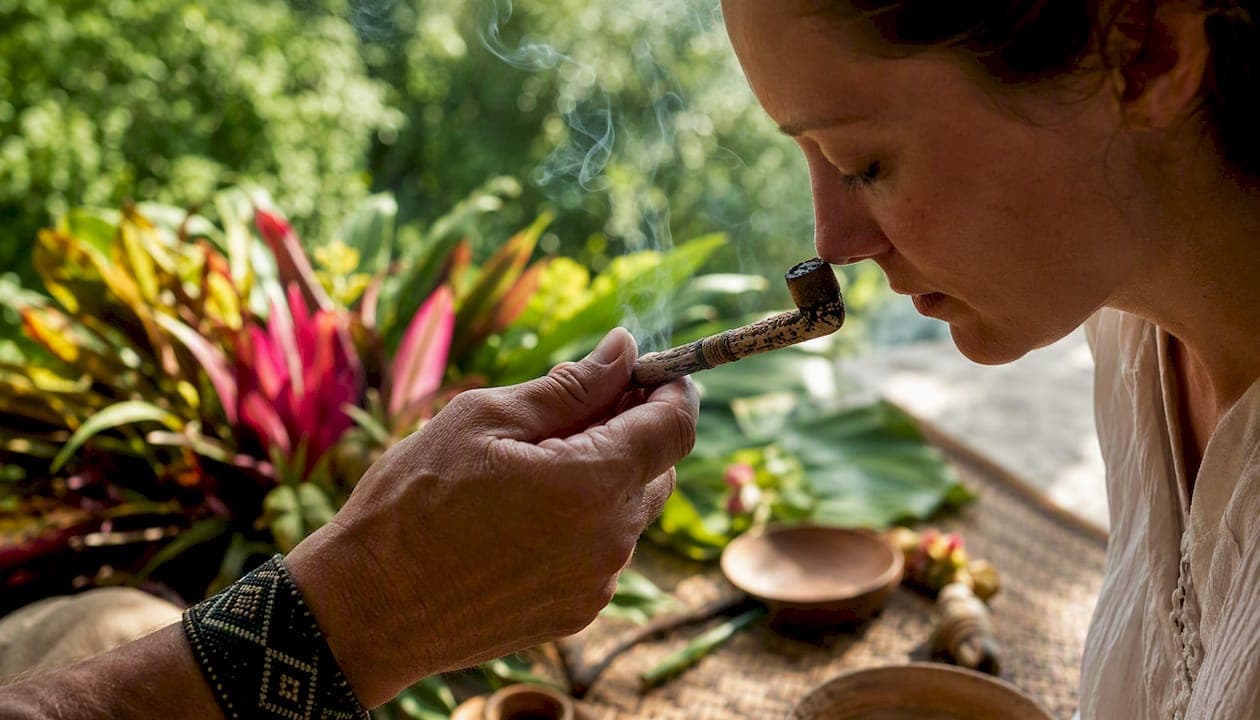
Breathwork primes the nervous system and shapes how rapé is absorbed, making the ceremonial experience safer, more grounded, and more purposeful. When you combine conscious breathing with sacred Amazonian snuff, the breath does more than calm nerves. It regulates mucosal blood flow, reduces gagging, and helps the body receive the medicine rather than resist it. The role of breath work with rapé is not ceremonial decoration. It is functional, pharmacologically relevant, and worth understanding before you sit.
Key benefits of pairing breathwork with rapé:
- Clearer absorption: Calm nasal passages with good blood flow take up the medicine more evenly.
- Calmer nervous system: Slow diaphragmatic breathing lowers sympathetic arousal before application.
- Manageable intensity: Controlled exhales and throat lock reduce the shock of initial delivery.
- Better integration: Grounding breath cycles after application help the body process rather than fight the experience.
This article is for general educational purposes only. If you have cardiovascular disease, respiratory illness, psychiatric conditions, pregnancy, or take any medications, consult a licensed healthcare provider before working with rapé or any plant medicine.
Key Takeaways
Breathwork is not supplementary to rapé ceremony. It is a functional part of how the medicine is received, absorbed, and integrated.
| Point | Details |
|---|---|
| Breath primes absorption | Calm nasal passages with good blood flow receive rapé more evenly and efficiently. |
| Throat lock is non-negotiable | Contracting the back of the throat after application keeps powder in the sinuses, not the lungs. |
| Start small, breathe slow | Minimal portions and slow diaphragmatic breath reduce the risk of gagging, panic, or distress. |
| Safety comes first | Cardiovascular disease, pregnancy, and certain psychiatric conditions are contraindications; consult a clinician. |
| Pillars of Light hap'e | Offers 75+ ethically sourced blends, handcrafted kuripés and tepis, and guided ceremonial support from Texas. |
Table of Contents
- What is rapé (hapé) and how is it traditionally used?
- How does ceremonial breathwork affect your body and mind?
- How do breathwork and rapé actually interact?
- Rapé breath technique step by step: a practical ceremony sequence
- Who should not use rapé, and when to seek help?
- Why ethical sourcing matters when you work with Amazonian medicine
- A perspective from Manifest Light
- Pillars of Light hap'e: ceremonial tools and blends, ethically sourced from Texas
- Sources
What is rapé (hapé) and how is it traditionally used?
Rapé is a traditional Amazonian snuff administered exclusively through the nose. Indigenous tribes across the Amazon basin have used it ceremonially for generations, as a tool for prayer, energetic clearing, and connection to plant intelligence. It is never smoked or ingested orally.
Most blends combine finely powdered tobacco (Nicotiana rustica) with tree ash and secondary plants. The tree ash is not filler. It raises the pH of the powder, shifting nicotine into its free-base form and making mucosal absorption faster and more efficient than smoking or oral routes. That alkalinity is why rapé acts quickly and why breath management during application matters so much.
Common ingredients and their roles:
- Mapacho tobacco: The primary active plant, high in nicotine alkaloids.
- Tree ash (tsunu, murici, and others): Raises pH to accelerate free-base nicotine uptake through nasal mucosa.
- Secondary plants: Vary by blend and tradition; may include medicinal herbs, resins, or bark.
Two tools carry the medicine into the nose. The tepi is a longer pipe, typically 15–35 cm, used by a facilitator who blows the rapé into the recipient's nostril. The kuripé is a shorter V-shaped or L-shaped pipe, 5–15 cm, designed for self-application. Tepi sessions are relational and ceremonial. Kuripé practice suits daily personal work or solo ceremony. Pillars of Light hap'e carries handcrafted versions of both, alongside 75+ ceremonial blends sourced with Indigenous respect.
How does ceremonial breathwork affect your body and mind?
Breathwork, in the ceremonial sense, is intentional regulation of breathing rhythm and depth to shift autonomic state. It is not hyperventilation. The techniques most relevant to rapé use are grounding and stabilizing, not activating.
Slow diaphragmatic breathing increases vagal tone, which moves the nervous system toward parasympathetic dominance. That shift matters because a relaxed nasal passage has better mucosal blood flow, which means the medicine distributes more evenly and absorbs more completely. A tense, shallow-breathing recipient often experiences more pressure, more nausea, and a harder landing.
Three breath patterns work well alongside rapé:
- Centering breath (pre-ceremony): Four to six slow cycles, inhaling through the nose and exhaling through the mouth. Sets intention and opens nasal passages.
- Slow diaphragmatic cycles: Belly-led breathing that keeps the chest soft. Reduces sympathetic arousal before application.
- Gentle active exhale (during tepi delivery): The recipient exhales slowly as the facilitator blows. This creates mild negative pressure in the nasal passage, drawing the powder inward rather than forcing it.
The nervous system reset that breathwork initiates is not metaphorical. Nasal patency, mucosal blood flow, and autonomic state all influence how the body receives the medicine. Breath is the lever you control.
How do breathwork and rapé actually interact?
The interaction is both mechanical and physiological. Tree ash alkalinity frees nicotine for rapid mucosal uptake, but the rate and evenness of that uptake depend on the condition of the nasal tissue at the moment of application. Calm, well-perfused mucosa absorbs more efficiently. Tense, constricted tissue creates uneven distribution and sharper initial intensity.

Timing the breath correctly changes the experience significantly.
Before application: Three to six centering breaths settle the nervous system and open the nasal passages. This is not optional preparation. It is the first step of the ceremony.
During application: The recipient exhales gently as the facilitator delivers the soplada through the tepi. Immediately after the blow, the recipient holds the breath briefly and applies a throat lock, contracting the back of the throat as if preparing to go underwater. This creates a pressurized chamber that keeps the powder in the sinuses for absorption rather than allowing it to drop into the throat or lungs.
After application: Slow, grounded breathing supports integration. Tears, salivation, and nasal pressure are normal autonomic responses to nicotine exposure and the body's clearing process. Breathwork keeps these responses from escalating into panic.
Common physical responses to expect: intense nasal and forehead pressure, tearing, mild sweating, salivation, and occasional nausea. These are documented autonomic responses to nicotine and the body's natural clearing. Slow, steady breathing after application modulates all of them.
Rapé breath technique step by step: a practical ceremony sequence
Preparation checklist:
- Choose a quiet, clean space with good ventilation.
- Sit upright with a straight spine, either cross-legged or in a chair.
- Hydrate beforehand; avoid heavy food for two hours prior.
- Disclose any medications or health conditions to your facilitator.
- Have tissues, a bowl for saliva, and water within reach.
Step-by-step sequence:
- Set intention (5–10 minutes): Sit quietly. State your intention aloud or silently. Begin four to six centering breaths, inhaling through the nose and exhaling through the mouth.
- Load the tool: For kuripé, load a small portion into the V-junction. For tepi, the facilitator loads one end. Start with a minimal portion; too large a dose increases the chance of gagging or distress.
- Position and cue: Tilt the head slightly forward. The facilitator places the tepi at the nostril. The recipient exhales slowly and steadily.
- Application and throat lock: The facilitator delivers the soplada with deliberate, measured breath, not force. The soplada is relational, transmitting intention alongside medicine. Immediately after the blow, the recipient contracts the back of the throat and holds briefly.
- Repeat for the second nostril: Allow 30–60 seconds between nostrils. Breathe slowly between applications.
- Integration breathing (10–30+ minutes): After both nostrils, sit with slow diaphragmatic breath. Allow tears, saliva, and pressure to move through without resistance. Grounding breath cycles, four counts in and six counts out, support the body's processing.
Tool hygiene: Clean kuripé and tepi after each use with a dry cloth or pipe cleaner. Never share applicators without thorough cleaning.
Pro Tip: If you feel overwhelmed during integration, place one hand on your belly and breathe into it. The physical anchor interrupts the panic loop faster than any mental technique.
Time estimates: preparation, 5–15 minutes; application per nostril, a few seconds; integration, 10–30 minutes or longer.
Who should not use rapé, and when to seek help?
Rapé is not appropriate for everyone. The nicotine load and autonomic activation it produces create real physiological demands.
Do not use rapé if you have: cardiovascular disease, uncontrolled hypertension, heart arrhythmia, severe asthma or COPD, pregnancy, active psychosis or certain psychiatric diagnoses, or if you are currently using nicotine replacement therapy or stimulant medications. Consult a licensed healthcare provider before any ceremonial plant medicine work if you have any of these conditions.
Seek emergency care immediately if you experience: prolonged difficulty breathing, loss of consciousness, chest pain, or severe vomiting with signs of dehydration.
Practical mitigation for everyone else: start with the smallest possible portion, remain seated throughout, work with a sober and experienced facilitator, and pause the session if symptoms escalate beyond what slow breathing can settle. Somatic breathwork techniques, including those explored in regression and breath-based therapeutic work, share this same principle: the nervous system needs a skilled witness when intensity rises.
This is general information, not medical advice. Confirm your suitability with a qualified healthcare professional before working with any plant medicine.
Why ethical sourcing matters when you work with Amazonian medicine
Rapé is not a commodity. It comes from living traditions held by specific peoples in specific places. How you source it reflects whether you are a participant in reciprocity or extraction.
A practical checklist for evaluating sourcing:
- Transparency of origin: Does the supplier name the tribe or region and the producers?
- Fair-trade procurement: Are Indigenous producers compensated fairly, not just symbolically?
- Rainforest support: Does the company contribute to conservation or cultural preservation efforts?
- Educational commitment: Does the supplier provide context, not just product?
Reciprocity also means how you show up. Attending a ceremony with a trained facilitator, learning from Indigenous teachers when possible, and approaching the medicine with genuine respect rather than curiosity-tourism all matter. The Amazonian healing traditions behind rapé carry centuries of relational knowledge. That knowledge deserves more than a transaction.
A perspective from Manifest Light
The most common mistake people make with rapé is treating the breath as background. They focus on the medicine, the tool, the facilitator, and forget that the breath is the one variable entirely within their control. Every physical response, from the pressure behind the eyes to the wave of nausea, is modulated by how you breathe in the moments before, during, and after application.
What the pharmacology confirms is what traditional practitioners have always known: the nose is not just a delivery route. It is a gateway whose condition, blood flow, tension, and openness, determines what the medicine does. Breathwork is not preparation for rapé. It is part of the ceremony itself.
Pillars of Light hap'e approaches this work from that same understanding. The educational resources and ceremonial tools the brand offers are built around safety-first practice, ethical sourcing, and genuine respect for the traditions that gave this medicine to the world.
Pillars of Light hap'e: ceremonial tools and blends, ethically sourced from Texas
The sharpest advantage Pillars of Light hap'e offers practitioners is depth of selection paired with sourcing you can trust. With 75+ ceremonial blends and handcrafted kuripé and tepi tools shipped from Old Town Spring, Texas, you are not choosing between variety and integrity. You get both.

The ceremonial items collection includes everything covered in this guide: blends suited to different intentions and experience levels, self-application kuripés for personal practice, and facilitator-grade tepis for ceremony work. Spiritual consultations and guided ceremonies are also available for those who want experienced support before sitting alone. Every product reflects a commitment to Indigenous respect and rainforest conservation. Browse the collection or book a consultation at Pillarsoflighthape.
Sources
- Rapé: The Ultimate Guide to Amazonian Snuff – amama
- Tepi and Kuripe: Tools for Rapé Application – amama
- How to Give Someone a Soplada of Sacred Amazonian Hape Medicine – Step by Step - EntheoNation
This article is general information, not a substitute for advice from a qualified doctor. Consult a qualified healthcare professional about your own circumstances before acting on anything here.