In plant medicine, "ash" carries two distinct meanings you need to keep separate. The first is ash value, a pharmacognostic lab metric that measures inorganic residue to detect contamination or adulteration in botanical materials. The second is plant-derived ash, the mineral-rich material produced by burning plant matter, used intentionally as an ingredient in ceremonial preparations like Amazonian Hapé blends. Confusing the two can lead to real safety errors. Industrial ash sources can carry heavy metals, and Fraxinus-based ash preparations interact with diuretics, diabetes medications, and blood-pressure drugs. Pillars of Light hap'e offers ethically sourced ceremonial materials and educational resources to help you navigate both meanings with confidence.
Table of Contents
- How ash functions in plant medicine: the two meanings you must know
- What ash value tests actually measure, and how to read them
- What minerals plant ash actually supplies, and why that matters
- What tradition and clinical evidence say about Fraxinus (Ash trees)
- Safety, interactions, and who should not use ash preparations internally
- How to source and handle ash-containing ceremonial materials responsibly
- What to ask your supplier: a lab-report checklist
- Key Takeaways
- What responsible practice actually looks like
- Pillars of Light hap'e: verified materials for serious practitioners
- Useful sources
How ash functions in plant medicine: the two meanings you must know
These two concepts share a name but serve entirely different purposes.
Ash value is a standardized pharmacognostic measurement. When a lab incinerates a plant sample and weighs what remains, that residue is the ash value. It tells quality-control teams whether a botanical contains excessive inorganic matter from contamination, adulteration, or poor processing. It says nothing about whether ash was intentionally added.
Plant-derived ash is a physical ingredient. Practitioners burn specific plant materials, collect the resulting ash, and incorporate it into preparations for its mineral content and ceremonial significance. In Amazonian traditions, certain Hapé blends include ash from sacred trees or vines as a deliberate component.
The practical contrast:
- Lab report context: A total ash value of 12% on a Hapé certificate of analysis signals a quality-control question, not a ritual choice.
- Ceremony blend context: Ash from a specific Amazonian tree is added to a blend intentionally, contributing potassium, calcium, and magnesium alongside its spiritual significance.
What ash value tests actually measure, and how to read them
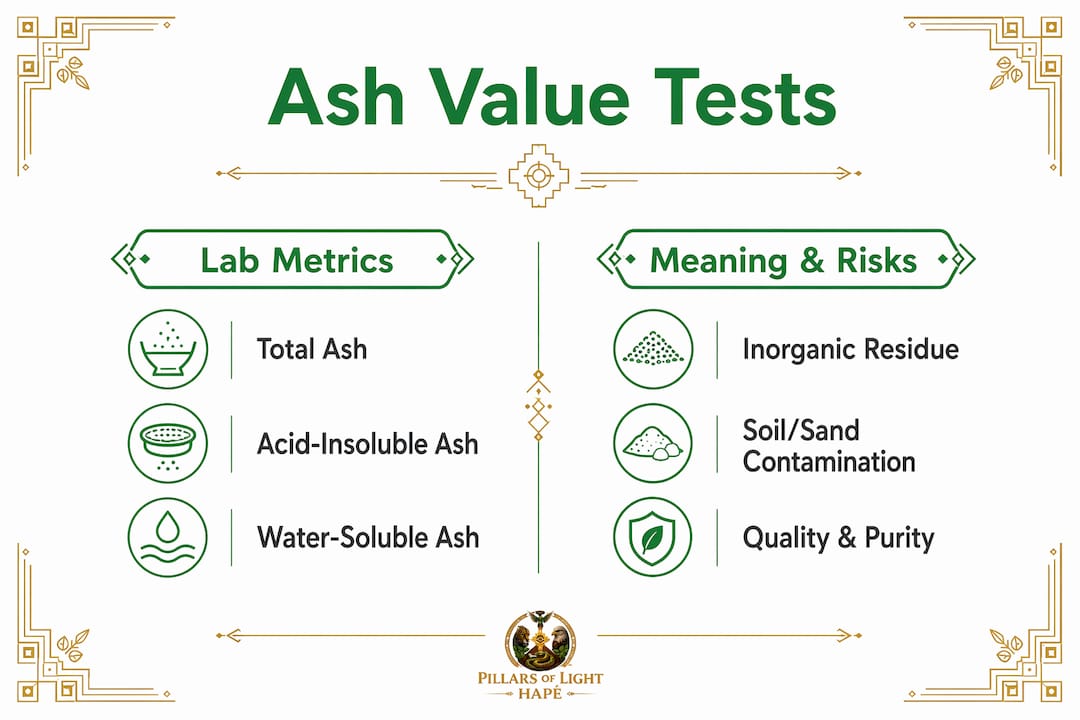
Three tests form the standard pharmacognostic toolkit for ash value analysis:
| Test | What it measures | Red flag |
|---|---|---|
| Total ash | All inorganic residue after incineration | Exceeds species-specific pharmacopeial limit |
| Acid-insoluble ash | Siliceous matter (sand, soil) that resists acid | Elevated values suggest soil contamination or adulteration |
| Water-soluble ash | Salts and soluble minerals dissolved in water | Abnormally high or low values indicate processing irregularities |
Acid-insoluble ash is the most telling of the three. A high reading almost always points to soil or sand contamination, which can mean the plant was harvested carelessly or the material was cut with filler. Values exceeding species-specific pharmacopeial limits are a strong signal to pause and investigate before any internal or inhalation use.
Low total ash is not automatically better. Processing can strip beneficial mineral content from a preparation that was designed to be mineral-rich. Interpreting these numbers requires knowing whether the preparation is meant to be a pure botanical extract or a nutrient-rich ritual blend.
Pro Tip: When requesting a certificate of analysis from a supplier, ask specifically: "Can you provide total ash, acid-insoluble ash, and water-soluble ash values alongside a heavy-metals panel?" Suppliers who cannot answer that question clearly are worth reconsidering.
What minerals plant ash actually supplies, and why that matters
Physico-chemical analysis of ash from medicinal plant species shows variable mineral profiles depending on species, plant part, and processing method. The most commonly detected elements are:
| Mineral | Role in preparations |
|---|---|
| Potassium (K) | Electrolyte balance; influences diuretic effects |
| Calcium (Ca) | Structural and enzymatic functions |
| Magnesium (Mg) | Muscle and nerve function; bioavailability modulator |
| Trace zinc, selenium | Antioxidant and immune-modulating activity |
These minerals can meaningfully affect how a preparation behaves in the body. Potassium-rich ash in a diuretic blend amplifies fluid-loss effects. Magnesium can influence how phytochemicals are absorbed. This is why knowing the botanical origin of any ash in your materials is not a formality. It is a safety variable.
On the cultivation side, controlled ash incorporation can improve soil pH and nutrient availability for medicinal crops. At higher application rates, however, toxic element buildup becomes a genuine risk, and that contamination can transfer into the plant tissue you eventually harvest or purchase.
What tradition and clinical evidence say about Fraxinus (Ash trees)
The genus Fraxinus, the botanical ash trees, carries a long history in European and Indigenous herbal traditions. The European Medicines Agency's assessment of Fraxinus excelsior documents traditional uses going back to Hippocrates: ash leaf as a diuretic and remedy for rheumatic pain, fever, gout, constipation, and urinary complaints. The Royal Botanic Gardens, Kew notes that ash bark was used to treat fevers, and ash sap was historically applied for earaches.
The clinical evidence, however, remains limited. The German Commission E listed ash bark and leaf among unapproved herbs, and the EMA's own assessment is direct:
WebMD's clinical summary and RxList both reiterate that more evidence is needed before therapeutic claims can be made with confidence. Traditional use is plausible given the known chemistry of flavonoids, coumarins, and mannitol in ash leaf, but plausibility is not proof. Any preparation you use in ceremony should be evaluated on its own merits, not assumed effective based on folk usage alone.
Safety, interactions, and who should not use ash preparations internally
This is where practitioners carry the most responsibility. Ash preparations with diuretic activity require careful participant screening.
Avoid internal use or proceed only with clinician coordination for participants who:
- Have cardiac insufficiency or congestive heart failure
- Have kidney disease or impaired renal function
- Take prescription diuretics (fluid-balance risk compounds)
- Take diabetes medications (ash may lower blood sugar)
- Take blood-pressure medications (ash may lower blood pressure)
- Are pregnant or nursing
Practitioner safety literature is clear that ash preparations used for diuretic effects require high fluid intake and are contraindicated in cardiac and kidney conditions due to fluid-balance risks. The Commission E monograph reinforces the conservative position: therapeutic claims must be validated for the specific preparation, not assumed from category.
In-ceremony hydration and monitoring checklist:
- Offer water before, during, and after ceremony
- Document any participant medications at intake
- Monitor for dizziness, rapid heartbeat, or unusual fatigue
- Have a clear protocol for pausing or ending ceremony if symptoms arise
- Consult a clinician before working with participants on multiple medications
How to source and handle ash-containing ceremonial materials responsibly
Sourcing is where safety and ethics meet. Industrial or environmental ash sources can carry heavy metals or other toxic elements. Only botanical-origin ash, verified by third-party testing, belongs in ceremony. When evaluating a supplier, ask about ethical sourcing practices and whether they can trace the ash back to a specific plant species and production method.
Storage matters too. Keep ash-containing materials in dry, labeled, airtight containers. Avoid cross-contamination with other botanicals. Label containers with the botanical name, harvest date, and supplier. For safe handling at home, the same principles apply: clean tools, clear labeling, and no improvised substitutions.
Pro Tip: Ask your supplier directly: "Was this ash produced from wood combustion, whole plant incineration, or another method?" The answer tells you a great deal about mineral profile and contamination risk.
What to ask your supplier: a lab-report checklist
Before using any ash-containing material in ceremony, request the following from your supplier:
- Total ash value with species-specific reference range
- Acid-insoluble ash value to rule out soil or sand contamination
- Water-soluble ash value for soluble mineral profile
- Heavy-metals panel covering lead (Pb), cadmium (Cd), arsenic (As), and mercury (Hg)
- Certificate of botanical identity (macroscopy, microscopy, or DNA verification)
- Harvest date and location
- Production method for any ash component (what was burned, how, and where)
- Chain-of-custody or ethical sourcing statement
- Third-party lab name and contact information
Suppliers who provide this documentation without hesitation are the ones worth building relationships with. Those who cannot or will not are telling you something important.
Pro Tip: A simple email opener that works: "Before placing an order, could you share your most recent certificate of analysis including total ash, acid-insoluble ash, heavy-metals screening, and botanical identity verification? We require this for all ceremonial materials we use."
Key Takeaways
Ash in plant medicine means two testable, distinct things: a lab quality metric and a mineral-rich ceremonial ingredient, and treating them as separate is the foundation of safe practice.
| Point | Details |
|---|---|
| Distinguish ash value from ash ingredient | Ash value is a lab purity metric; plant-derived ash is an intentional mineral ingredient in ceremony blends. |
| Verify botanical origin and heavy-metal safety | Always request total ash, acid-insoluble ash, and a full heavy-metals panel (Pb, Cd, As, Hg) before ceremonial use. |
| Screen participants for diuretic and mineral risks | Avoid internal ash preparations for anyone with cardiac, kidney, diabetes, or blood-pressure conditions without clinician guidance. |
| Pillars of Light hap'e | Offers ethically sourced ceremonial materials and educational resources for practitioners who want verified, transparent sourcing. |
What responsible practice actually looks like
The conversation around ash in ceremonial plant medicine tends to collapse two very different concerns into one. Practitioners worry about purity, and rightly so. But the deeper question is whether the materials you carry honor the traditions they come from.
Ash has been part of Amazonian plant medicine for generations, not as a contaminant to screen out, but as a living component of the preparation. The minerals it carries, the plants it came from, the hands that processed it: all of that is part of what you bring into ceremony. Reducing it to a line on a lab report misses something. Ignoring the lab report entirely misses something else.
The indigenous plant medicine traditions that gave us these practices did not separate safety from reverence. They were the same thing. When you ask a supplier for a certificate of botanical identity, you are not being overly cautious. You are doing what the tradition has always asked: know what you are working with, where it came from, and whether it was treated with respect.
Pillars of Light hap'e holds that standard as a baseline, not a ceiling.
Pillars of Light hap'e: verified materials for serious practitioners
Practitioners who want ceremonial materials they can actually trace have a clear option. Pillars of Light hap'e, based in Old Town Spring, Texas, carries 75+ varieties of Hapé alongside handcrafted Kuripes, Tepis, and master plant allies, all sourced with documented attention to Indigenous traditions and rainforest preservation.

The difference here is transparency. Pillars of Light hap'e supports practitioners in asking the right questions about what goes into their blends, including ash components, botanical identity, and sourcing chain. For practitioners ready to work with materials they can stand behind, the ceremonial items collection is the place to start. Those looking to deepen their relationship with plant allies can explore the master plant allies page for ethically sourced options with educational context.
Useful sources
- EMA Assessment Report: Fraxinus excelsior L. folium — The most authoritative clinical and traditional-use review of ash leaf; covers historical indications, evidence limits, and pharmacopeial status.
- HerbalGram: Commission E Monograph, Ash Bark and Leaf — The regulatory basis for conservative therapeutic claims; explains why ash remains in the "unapproved herbs" category.
- WebMD: Ash — Consumer-facing clinical summary covering traditional uses, interactions, and safety flags for practitioners.
- RxList: Ash — Concise evidence summary; useful for participant screening language and diuretic-effect notes.
- Arzneipflanzenlexikon: Ash (Fraxinus) Safety Notes — Practitioner-oriented safety guidance on fluid-balance risks and contraindications.
- Royal Botanic Gardens, Kew: European Ash — Botanical background and traditional herbal uses of Fraxinus excelsior.
- Pexacy: The Science of Ash Values in Pharmacognosy — Review of how ash value analysis is evolving toward a diagnostic tool linking mineral profiles with therapeutic potential.
- Physico-Chemical Analysis of Ash of Some Medicinal Plants (EIJPR) — Empirical mineral data from medicinal plant ash; supports the variable-profile argument for species-specific testing.
- Frontiers in Sustainability: Fly Ash in Medicinal Plant Cultivation — Agronomic research on ash in soil; covers both benefit windows and toxic-element buildup risks.