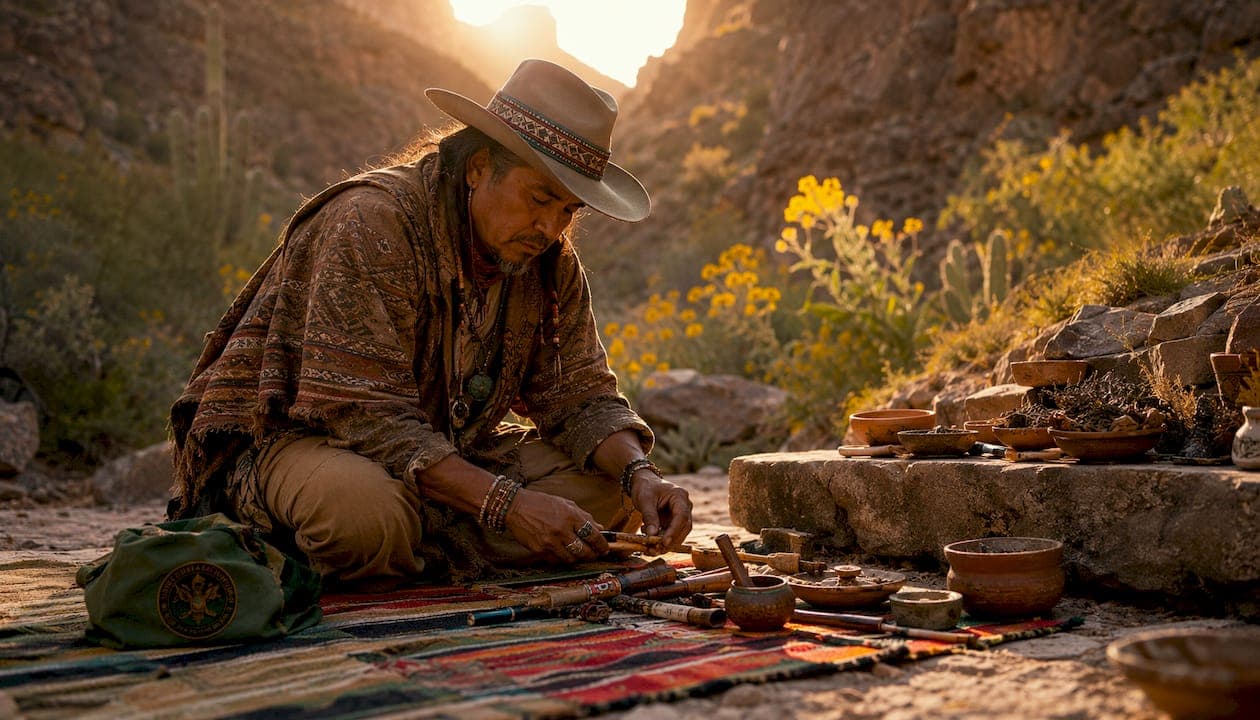
Hapé desert ceremony practices center on the respectful, intentional administration of Amazonian ceremonial snuff in an open-air desert setting, with the single most important requirement being this: never attempt it without medical screening and either an experienced facilitator or careful, informed self-application. This is sacred medicine, not a casual ritual.
Before you go further:
- Hapé (also called rapé, pronounced "ha-PAY") is a finely ground ceremonial snuff made from tobacco and plant ashes, administered through the nose.
- Desert settings introduce real physical variables: heat, UV exposure, wind, and dehydration that demand extra preparation.
- Respectful practice means honoring the Indigenous custodians who created and transmitted this medicine.
Medical screening is not optional. Anyone with cardiovascular conditions, pregnancy, severe psychiatric diagnoses, or who takes MAOIs or SSRIs must consult a physician before participating. See the full contraindications section below.
Pro Tip: Read this guide fully before your first ceremony. The preparation and aftercare sections are just as important as the application steps.
Table of Contents
- What is Hapé and where does it come from?
- Why people use Hapé: ceremonial purpose and reported benefits
- How a Hapé ceremony is structured
- Tools, blends, and ethical sourcing in the U.S.
- How to administer Hapé: tepi and kuripe step-by-step
- Preparing for a desert Hapé ceremony: your checklist
- What to expect during and after a Hapé ceremony
- Integration and aftercare: your 7-day plan
- Safety, contraindications, and legal considerations in the U.S.
- Pillars of Light hap'e practitioner checklist and desert ceremony script
- Key Takeaways
- The desert changes everything about how you hold ceremony
- Pillars of Light hap'e: ceremony-ready tools and guidance from Texas
- Useful sources and further reading
What is Hapé and where does it come from?
Hapé is a ceremonial snuff made primarily from Nicotiana rustica, a potent tobacco species, combined with the ashes of sacred plants and sometimes additional master plants chosen for their specific ceremonial properties. It is administered through the nose using a blowpipe, not smoked or ingested.
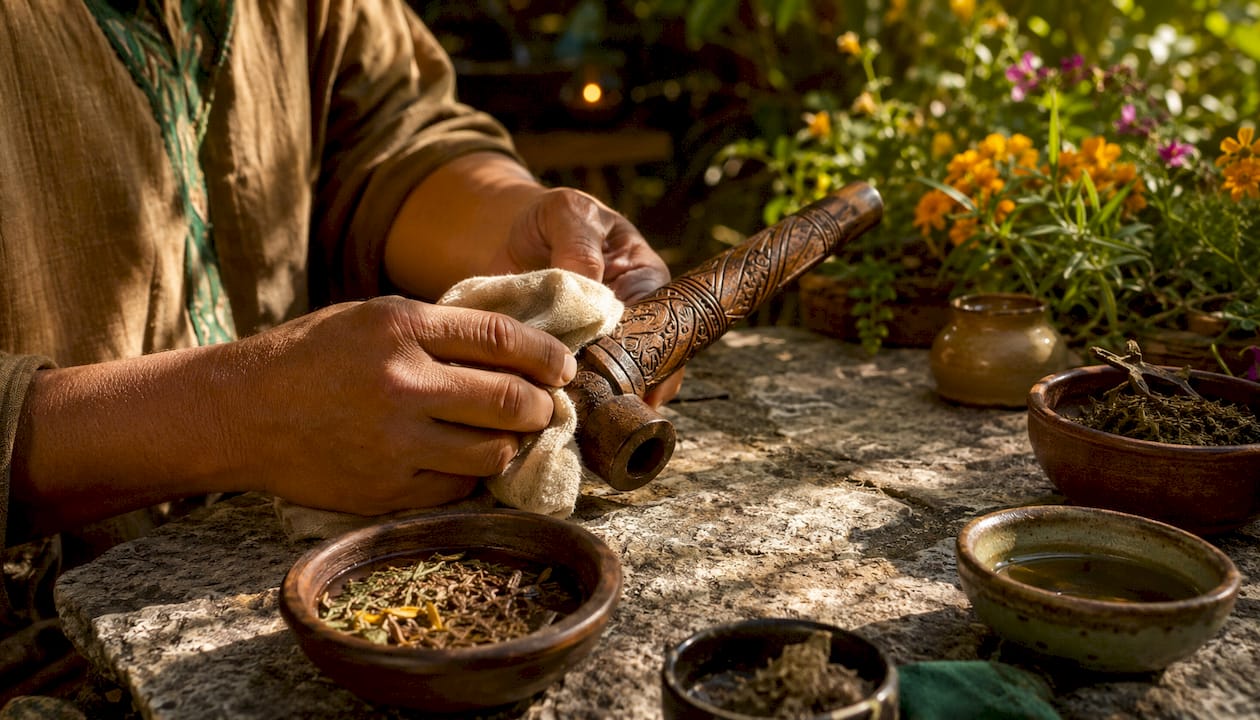
Its origins lie deep in the Amazon basin. Tribes including the Katukina, Yawanawá, and Nukini have used Hapé for generations as a tool for grounding, prayer, and energetic clearing. Recipes are guarded and transmitted within tribal lineages, and the knowledge of how to prepare and administer it is considered sacred custodial knowledge, not public domain.
In contemporary spiritual practice, Hapé appears in several contexts:
- Solo personal practice for grounding, focus, or meditation preparation
- Accompaniment to ayahuasca ceremonies, where it is used to prepare or clear energy before or after the main plant work
- Kambo sessions, where it helps ground the body before or after the intense physical purge
- Group desert ceremonies, the focus of this guide, where community, intention, and environment are all part of the medicine
The tools of a ceremony are simple but specific:
- Tepi: a two-ended blowpipe used by a facilitator to administer Hapé to a recipient
- Kuripe: a V-shaped self-applicator that allows solo administration
- Ceremonial bowl or vessel for holding the blend
- Prayer or opening blessing to set the container and intention
Cultural sensitivity matters here. Many tribal recipes remain secret by design. Purchasing Hapé from suppliers who maintain direct tribal partnerships and fair-trade sourcing is the minimum standard for respectful practice.
Why people use Hapé: ceremonial purpose and reported benefits
Hapé bypasses the digestive system entirely through nasal administration, which is part of why its effects are felt quickly and directly. Practitioners use it to ground the body, quiet mental noise, and prepare for deeper plant-medicine work.
The most commonly reported ceremonial intentions include:
- Grounding: anchoring awareness in the body and the present moment
- Energetic clearing: releasing stagnant or heavy energy before or after ceremony
- Mental focus: quieting excessive thinking and sharpening intention
- Emotional release: creating space for feelings that have been suppressed
- Preparation for deeper work: used alongside ayahuasca or Kambo to open and clear before the main medicine
Reported benefits, as described by practitioners and participants, include a sense of energetic cleansing, improved concentration, and emotional clarity. These are spiritual and experiential outcomes, not medical claims. Hapé is not a treatment for any condition.
Pro Tip: Match your blend to your intention. Heavier, earthier blends like tsunu tend toward grounding and stillness. Lighter blends with mulateiro-style ashes often support clarity and opening. Ask your supplier which blends fit your ceremony's purpose before you order.
How a Hapé ceremony is structured
The basic sequence of a Hapé ceremony moves from opening to intention-setting, through application, and into reflection. Left nostril receives the medicine first, then the right. That order is not arbitrary.
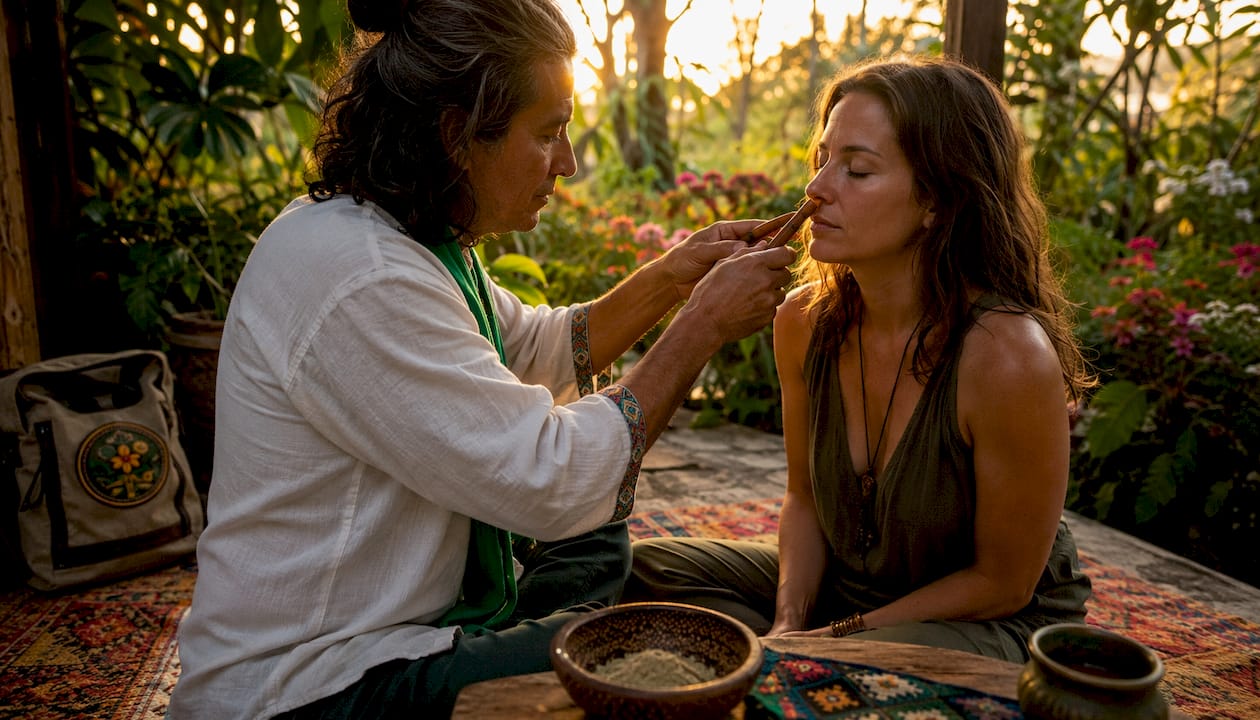
The left nostril first carries symbolic meaning in traditional practice: it represents the release of old energies, what you are letting go. The right nostril follows, symbolizing the intake of clarity or rebirth. Maintaining this order is a foundational discipline taught in ceremonial training.
Roles in ceremony
| Role | Responsibilities |
|---|---|
| Facilitator / Blower | Holds the tepi, sets intention before blowing, administers medicine with care and presence |
| Assistant | Supports recipients during strong reactions, manages tissues and water, monitors safety |
| Recipient | Arrives prepared, communicates health history, holds intention, surrenders to the process |
| Community | Maintains silence and respect during application, supports integration afterward |
Ceremony sequence checklist
- Open with prayer, smudging, or a spoken blessing to set the container
- Facilitator and recipient agree on intention aloud or in silence
- Recipient sits upright, feet flat, mouth slightly open
- Facilitator administers to left nostril first, then right, with a pause between
- Recipient sits in stillness for 5–15 minutes to receive the medicine
- Facilitator checks in verbally; assistant offers water and tissues
- Group moves into shared silence, breathwork, or gentle movement
- Closing gratitude or prayer completes the ceremony
When multiple rounds are used, typically in deeper ceremonial contexts, the same left-right sequence is repeated with a rest period between rounds. Timing between rounds should be at least 20–30 minutes to allow full integration of each application.
Tools, blends, and ethical sourcing in the U.S.
The right tool depends on the setting. A tepi requires two people: the blower places their breath, and with it their intention, directly into the medicine as it travels to the recipient. Experienced facilitators describe this as a relational transfer of life force, which is why the selection of a blower is not casual. A kuripe is designed for solo use, allowing self-application without a second person present.
Common Hapé blend families
| Blend Family | Primary Base | Common Ceremonial Use |
|---|---|---|
| Tsunu | Tsunu tree ash + tobacco | Deep grounding, stillness, heavy clearing |
| Parica | Parica plant ash + tobacco | Energizing, mental clarity, opening |
| Mulateiro-style | Mulateiro bark ash + tobacco | Lightening, emotional release, clarity |
| Katukina-style | Varies by tribal recipe | Broad ceremonial use, often grounding |
Blend choice is matched to ceremony intention by experienced practitioners. Different tribes produce distinct blends from local plants and ashes, and the same plant name can yield very different medicine depending on who prepared it and how.
Sourcing and ethics
When sourcing Hapé in the United States, ask these questions before purchasing:
- Does the supplier name the tribe or community of origin?
- Are tribal artisans and knowledge-holders compensated fairly?
- Is the supplier transparent about ingredients and preparation methods?
- Does the supplier support rainforest or cultural preservation programs?
Supplier transparency is not a marketing nicety. It is the difference between supporting living Indigenous traditions and extracting from them. Store blends in a cool, dry place away from direct sunlight, ideally in a sealed glass or wooden container. Wooden pipes should be kept clean, dry, and stored away from heat to prevent cracking. Shelf life for properly stored Hapé is typically one to two years, though freshness varies by blend.
How to administer Hapé: tepi and kuripe step-by-step
The short answer: sit upright, mouth slightly open, left nostril first, right nostril second, and use a pea-sized dose per nostril. Do not inhale sharply. Let the medicine settle.
Receiving Hapé via tepi (facilitator-administered)
- Sit on the ground or a low seat with your spine upright and feet flat.
- Open your mouth slightly to allow airflow during administration.
- Set your intention silently or aloud before the facilitator begins.
- The facilitator places a measured amount of Hapé into the tepi's bowl end.
- Place the tepi's nostril end gently at your left nostril.
- The facilitator blows steadily and firmly in one breath. Do not pull back.
- Sit with the sensation. Breathe slowly through the mouth.
- After a pause, repeat on the right nostril.
- Remain seated. Let sneezing, tearing, or clearing happen naturally.
Self-application with a kuripe
- Measure a small, pea-sized amount of Hapé into the kuripe's bowl.
- Sit upright. Set your intention.
- Place the nostril end at your left nostril and seal the other nostril gently with a finger.
- Exhale fully, then blow through the mouthpiece in one steady breath.
- Sit with the sensation. Breathe through the mouth.
- Repeat on the right nostril with a fresh measure.
Pro Tip: Less is more, especially for beginners. A pea-sized dose per nostril is the standard starting point. You can always receive more in a later round; you cannot undo too much.
Safety callouts
- Sneezing, tearing, spitting, and mild purging are normal and expected.
- If you feel chest tightness, racing heart, or difficulty breathing, stop immediately and seek fresh air.
- Never administer Hapé outdoors in high wind without a wind barrier. Loose desert sand entering the pipe or nostril is a real hazard.
- Always have tissues and water within reach.
Preparing for a desert Hapé ceremony: your checklist
The most common mistake in desert ceremony preparation is underestimating the environment. Heat, dehydration, and UV exposure compound the physical effects of Hapé in ways that indoor settings do not.
Core preparation checklist
- Food: eat lightly or fast for 4–6 hours before ceremony; avoid heavy, greasy, or processed foods
- Hydration: drink water consistently in the 24 hours before, but avoid excess in the hour immediately prior
- Medications: complete a full medication review (see safety section); flag all MAOIs, SSRIs, and cardiovascular medications
- Consent: verbal or written consent from all participants before the ceremony begins
- Toilet access: confirm restroom or private outdoor access within 2–3 minutes of the ceremony space
- Tissues: bring more than you think you need
- Loose, comfortable clothing: nothing tight around the chest or abdomen
The Silent Window
The Silent Window is a period of intentional quiet before and after ceremony. Before the ceremony, a minimum of 30–60 minutes of silence, no phone, no music, no conversation, allows the mind to settle and the intention to clarify. After the ceremony, a 1–2 hour silent window supports integration and prevents the medicine from being scattered by distraction.
Desert-specific environment checklist
- Shade: set up the altar and seating area under natural shade or a canopy; direct sun during application intensifies physical reactions
- Wind management: use a natural windbreak (rock formation, vehicle, fabric screen) to protect the ceremony space from gusts
- Sun protection: apply sunscreen before the ceremony, not during; avoid aerosol sprays near the ceremonial space
- Sand mitigation: lay a clean cloth or mat under the altar and seating area to prevent sand from entering pipes or blends
- Temperature: schedule desert ceremonies for early morning or late afternoon to avoid peak heat (typically 10 AM–4 PM in most U.S. desert regions)
Pre-ceremony timing table
| Window | Recommended Action |
|---|---|
| 24 hours before | Hydrate consistently; reduce alcohol, caffeine, and heavy foods |
| 4–6 hours before | Light fast or very light meal; begin the Silent Window if possible |
| 30–60 minutes before | Full silence; set intention; prepare the ceremonial space |
| Immediately before | Final bathroom visit; confirm consent; settle into seated position |
| 1–2 hours after | Maintain the Silent Window; journal; rest |
What to expect during and after a Hapé ceremony
The immediate sensations after administration are intense and brief. Most people experience a sharp burning in the nasal passages, followed by sneezing, tearing, and a wave of clearing that moves through the sinuses and sometimes the chest. This is the medicine working.
Timeline of effects
Minutes 0–10: Burning, sneezing, tearing, possible spitting or mild purging. The mind often goes quiet suddenly. Stay seated and breathe through the mouth.
Minutes 10–60: The acute phase passes. Many people report a deep stillness, heightened sensory awareness, or emotional surfacing. Some feel a strong urge to lie down. Follow what the body asks.
Hours 1–6: A grounded, clear quality often settles in. This is the integration window. Avoid screens, loud environments, and stimulating conversation.
Hours 24–72: Subtle shifts in mood, perception, or emotional processing may continue. Dreams can be vivid. Journaling during this window is especially productive.
Common symptoms vs. red flags
- Normal: sneezing, tearing, runny nose, mild nausea, brief dizziness, emotional release, purging
- Seek fresh air and rest: prolonged nausea beyond 30 minutes, strong dizziness, disorientation
- Seek medical attention immediately: chest pain, racing or irregular heartbeat, difficulty breathing, loss of consciousness, severe allergic reaction
Pro Tip: If someone in your ceremony group has a strong reaction, do not leave them alone. Have them sit or lie on their side, keep them warm, and stay present. Most reactions resolve within 20–30 minutes. If they do not, call 911.
Facilitators and experienced practitioners consistently recommend having tissues and restroom access ready before the first application. Physical purging is a recognized part of the energetic clearing process, not a sign that something has gone wrong.
Integration and aftercare: your 7-day plan
Three immediate actions after ceremony: ground physically (feet on earth, hands on a tree or stone), hydrate with clean water, and journal for 10–20 minutes while the experience is fresh. These three steps alone determine whether the ceremony becomes a lasting shift or a passing sensation.
Immediate grounding practices
- Stand or sit barefoot on natural ground for 5–10 minutes
- Breathe slowly and deliberately: four counts in, hold four, out four
- Eat something light and grounding: fruit, broth, or plain rice
- Avoid alcohol, cannabis, and stimulants for at least 24 hours
- Limit screen time for the remainder of the day
7-day integration timeline
- Day 1: Rest, hydrate, journal. Protect the Silent Window. Gentle walking only.
- Day 2: Continue journaling. Notice what emotions or thoughts are surfacing. Light movement.
- Day 3: Return to gentle routine. Avoid major decisions or confrontational conversations.
- Day 4: Reflect on your ceremony intention. Did it shift? What is asking for attention?
- Day 5: Consider a short breathwork session or meditation to deepen integration.
- Day 6: Share your experience with a trusted person or integration circle if available.
- Day 7: Write a closing journal entry. What has changed? What do you want to carry forward?
Journal prompts
- What was my intention going in, and did the medicine respond to it?
- What did I feel in my body during the acute phase?
- What emotions surfaced, and what might they be pointing to?
- What do I want to release, and what do I want to call in?
If integration feels destabilizing beyond day 3, or if you are experiencing persistent anxiety, dissociation, or intrusive thoughts, reach out to a mental health professional familiar with non-ordinary states of consciousness. The spiritual effects of Hapé can surface material that benefits from skilled support.
Safety, contraindications, and legal considerations in the U.S.
The short answer: Hapé is not safe for everyone. Medical screening before participation is required, not optional.
Contraindications
Do not participate in a Hapé ceremony if you have:
- Pregnancy or are actively breastfeeding
- Severe cardiovascular conditions (uncontrolled hypertension, arrhythmia, recent cardiac event)
- Active psychosis or a diagnosis of schizophrenia or bipolar I disorder without physician clearance
- Severe respiratory conditions (uncontrolled asthma, COPD)
- Recent nasal surgery or active nasal infection
Medication interactions
| Medication Category | Concern |
|---|---|
| MAOIs (monoamine oxidase inhibitors) | Serious interaction risk with tobacco alkaloids; do not combine |
| SSRIs / SNRIs | Potential serotonergic effects; consult physician before use |
| Beta-blockers / antihypertensives | Cardiovascular response may be unpredictable |
| Anticoagulants (blood thinners) | Purging and physical stress may increase risk |
| Stimulants (Adderall, Ritalin, etc.) | Compounding cardiovascular stimulation risk |
Legal note for U.S. readers
Hapé blends are primarily composed of Nicotiana rustica and plant ashes. Nicotiana rustica is not a federally controlled substance in the United States. However, some Hapé blends may contain additional plant materials whose legal status varies by state and jurisdiction. Laws change, and local ordinances can differ significantly from federal law. If you are organizing a group ceremony, consult a local attorney familiar with plant medicine law in your state. This article is general information, not legal advice.
Emergency protocol
If a participant loses consciousness, experiences chest pain, or cannot be roused, call 911 immediately. Do not attempt to continue the ceremony. Place the person in the recovery position (on their side) and stay with them until emergency services arrive.
Pillars of Light hap'e practitioner checklist and desert ceremony script
Pillars of Light hap'e operates from four non-negotiable practitioner rules: verified consent from every participant, confirmed provenance of all blends used, full medical screening before application, and clean sanitation of all tools between uses. These are the foundation, not the ceiling.
Full practitioner checklist
Pre-ceremony:
- Confirm all participants have completed a health and medication screening.
- Verify the provenance and tribal origin of every blend being used.
- Inspect and clean all tepis and kuripes before the ceremony.
- Scout and prepare the desert site: shade, wind barrier, clean mat, water supply.
- Brief all participants on the sequence, roles, and what to expect.
- Obtain verbal consent from each recipient before beginning.
Application:
- Open with a spoken blessing or prayer to set the ceremonial container.
- Measure each dose carefully; use a pea-sized amount per nostril as the baseline.
- Administer left nostril first, then right, with a deliberate pause between.
- Maintain presence and eye contact with the recipient throughout.
- Have an assistant monitor for strong reactions and manage tissues and water.
Post-ceremony:
- Close with gratitude: spoken acknowledgment of the medicine, the land, and the tribal custodians.
- Offer water and grounding support to all participants.
- Clean all tools immediately after the ceremony.
- Check in with each participant before they leave the space.
Sample desert ceremony script
Opening blessing: "We open this space with gratitude for the land beneath us and for the Indigenous peoples who have carried this medicine across generations. We set our intention with respect and humility."
Intention setting: Facilitator invites each participant to hold their intention silently for one full minute before application begins.
Application: "Receive this medicine with an open heart. Left nostril first, to release what no longer serves. Right nostril to receive clarity and renewal."
Administer left nostril. Pause. Administer right nostril. Sit in shared silence for 10–15 minutes.
Gratitude and closing: "We give thanks to the medicine, to the earth, and to each other. Carry what you have received gently."
Sanitation protocol
| Tool | Cleaning Method | Frequency |
|---|---|---|
| Wooden tepi | Wipe interior with a dry cloth; air dry fully | After every use |
| Kuripe | Blow clear with clean air; wipe exterior | After every use |
| Ceremonial bowl | Rinse with clean water; dry completely | After every ceremony |
| Storage containers | Wipe dry; keep sealed | Weekly or as needed |
Pro Tip: In desert heat, wooden tools dry out and can crack. After cleaning, apply a very light coat of natural oil (jojoba or coconut) to the exterior of wooden tepis and kuripes. Store them wrapped in cloth, away from direct sun and heat sources.
Cross-cultural ceremonial traditions, from Tuareg healers to Bedouin Dervish practitioners, consistently show that the presence of a knowledgeable custodian is what makes a healing space safe. The same principle applies here.
Key Takeaways
Hapé desert ceremony practices require respectful preparation, medical screening, and ethical sourcing to be both safe and spiritually meaningful.
| Point | Details |
|---|---|
| Medical screening is required | Anyone with cardiovascular conditions, pregnancy, psychiatric diagnoses, or MAOI/SSRI use must consult a physician first. |
| Left nostril before right | The left-then-right sequence carries traditional symbolic meaning and is a foundational discipline of ceremonial practice. |
| Desert prep adds extra steps | Schedule ceremonies in early morning or late afternoon, use shade and wind barriers, and hydrate consistently in the 24 hours before. |
| Integration determines the outcome | Journal, ground physically, and maintain a Silent Window after ceremony; the 7-day integration plan turns experience into lasting change. |
| Pillars of Light hap'e | Offers a wide variety of ethically sourced Hapé blends, handcrafted kuripes and tepis, and in-person desert-ready ceremonies from Old Town Spring, Texas. |
The desert changes everything about how you hold ceremony
Most Hapé guides are written for indoor settings: a quiet room, controlled temperature, a mat on the floor. The desert asks something different of you. It asks you to reckon with scale.
When you sit on open ground in the Sonoran or Chihuahuan desert and receive this medicine, the environment is not backdrop. It is participant. The wind, the heat, the silence that is not actually silence, the way the light shifts across rock and sand, all of it becomes part of the container. Practitioners who have worked in both settings consistently report that desert ceremonies carry a particular quality of rawness. There is nowhere to hide from what surfaces.
That is not a warning against desert practice. It is an argument for taking preparation more seriously than you might indoors. The Sonoran Desert's curandera traditions remind us that desert land has its own healing intelligence, and that working with it requires humility and knowledge, not just enthusiasm.
What gets underestimated most often is the relational dimension. The blower's intention travels with the medicine. The land holds the space. The tribal custodians who developed these blends over generations are present in the medicine itself. At Pillars of Light hap'e, every blend we carry comes with a named tribal origin and a sourcing relationship built on fair exchange. That is not a marketing claim. It is the minimum standard for working with this medicine honestly.
Desert ceremony is not more advanced than indoor ceremony. It is different. It rewards the practitioner who has done the inner work of preparation and the outer work of logistics with equal seriousness.
Pillars of Light hap'e: ceremony-ready tools and guidance from Texas
For seekers who want to practice with integrity, the hardest part is often finding blends and tools you can actually trust. Pillars of Light hap'e carries 75+ varieties of ceremonial Hapé sourced directly through tribal partnerships, alongside handcrafted kuripes and tepis made by Amazonian artisans. Every product ships from Old Town Spring, Texas, with full provenance information.
Whether you are preparing for your first desert ceremony or deepening an established practice, the ceremonial tools collection includes everything from entry-level kuripes to hand-carved tepis from the Shipibo tradition. In-person spiritual consultations and guided ceremonies are also available for those who want experienced facilitation rather than solo practice. Browse the full collection or book a consultation at pillarsoflighthape.com and bring the right medicine to your next desert ceremony.
Useful sources and further reading
The following sources informed this guide and are recommended for readers who want to go deeper:
-
Hapé: Roots and Rituals of Ceremonial Snuff — Reality Sandwich: Covers ceremonial mechanics, nostril sequence symbolism, and blend selection. One of the more thorough English-language overviews of practical ceremony structure.
-
Hapé — The Plant Medicine Path: Explains the relational transfer element of tepi administration and the role of the blower's intention. Good foundational reading on facilitator responsibility.
-
What Is Hapé? — Make & Mary: Accessible overview of reported spiritual and experiential benefits; useful for readers new to the medicine.
-
What to Expect from a Rapé Ceremony — Avalon: Situates Hapé within broader ayahuasca and Kambo ceremony contexts; helpful for understanding how it fits into multi-medicine practice.
-
Ayahuasca: Uses, Side Effects, Risks and Safety — WebMD: Mainstream medical overview of ayahuasca ceremony structure; relevant for understanding the broader ceremonial context in which Hapé is often used.
-
Traditional Tuareg Healing Practices — Atlas of Disappearing Worlds: Cross-cultural perspective on custodial healing knowledge; supports the principle that ceremonial medicine requires knowledge-holders, not just participants.
-
Saguaro Land: A curandera on the healing properties of the Sonoran Desert — KJZZ: Felicia Ruiz's perspective on the Sonoran Desert as a living medicinal environment; grounds the desert-adaptation sections in a real practitioner's voice.
-
Nicotiana rustica — Wikipedia: Botanical reference for the primary tobacco species used in Hapé blends; useful for readers researching the plant's properties and legal status.
"We live in one of the most edible and medicinal environments in the world, here in the Sonoran Desert." — Felicia Ruiz, curandera, as quoted by KJZZ
-
Pillars of Light hap'e — Amazonian Healing Traditions Explained: Broader context on Amazonian ceremonial systems and how Hapé fits within them; written from the publisher's practitioner perspective.
-
Pillars of Light hap'e — Why Amazonian Plants Are Sacred: Indigenous perspectives on plant sacredness and ethical sourcing; essential reading for anyone sourcing Hapé in the United States.