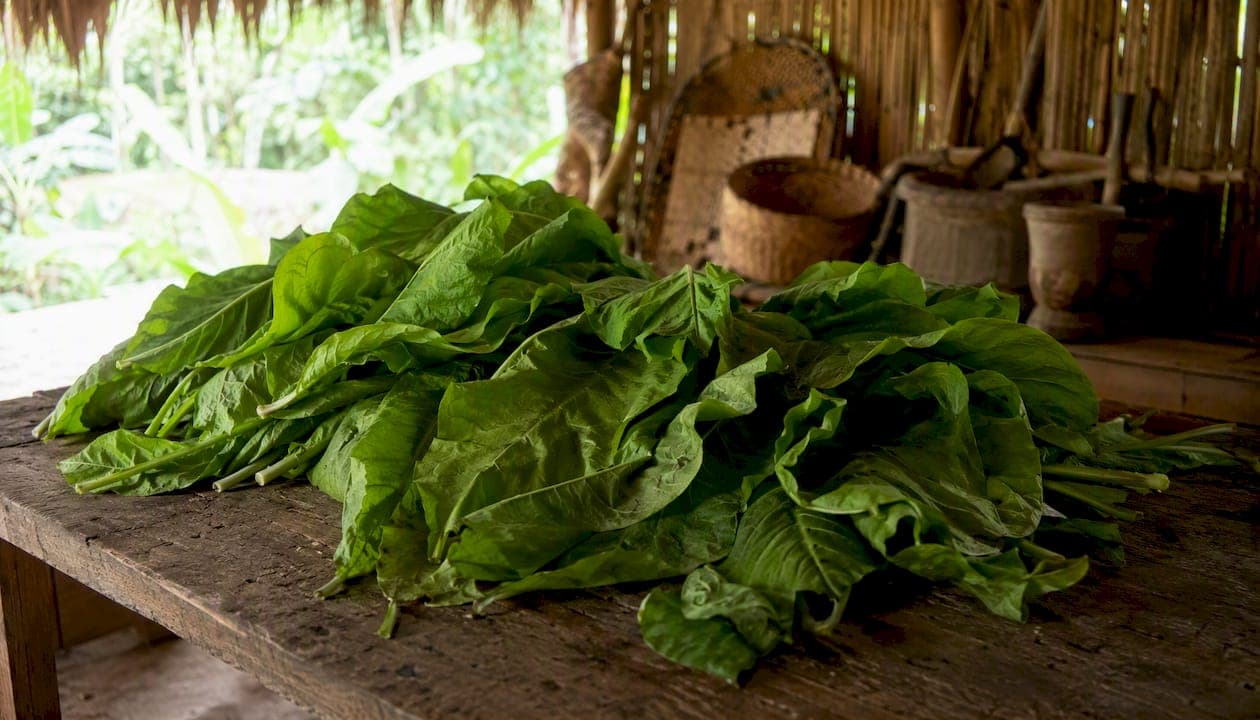
Nicotiana rustica (mapacho) is the pharmacological and ceremonial core of most rapé blends. Its exceptionally high nicotine content, combined with alkaline plant ashes, produces rapid nasal absorption of free-base nicotine that both grounds the body and functions as a ritual teacher in Amazonian practice. Two facts anchor everything else: peer-reviewed analysis has measured total nicotine in hand-made rapé samples varying widely among products, and the alkaline ash blended into every traditional preparation pushes pH to 9.75–10.2, driving un-ionized nicotine up to 18.5 mg/g in high-pH samples. No other ingredient does more to shape what rapé is, chemically or spiritually.
The three pillars of mapacho's role in rapé are:
- Pharmacological core: High total nicotine plus alkaline ash creates free-base nicotine that absorbs rapidly through nasal mucosa, producing fast-onset physiological effects.
- Ceremonial teacher plant: Across many Amazonian lineages, mapacho is revered as a protector, guide, and medicine in its own right, not merely a delivery vehicle.
- Technical foundation: The ash-to-tobacco ratio and particle fineness directly control pH, bioavailability, and the intensity of nasal sensation.
Medical disclaimer: Rapé contains high levels of nicotine and measurable tobacco-specific toxicants. If you have cardiovascular disease, uncontrolled hypertension, a psychiatric condition, or are pregnant or nursing, consult a physician before any exposure. This article is general information, not medical advice.
Pro Tip: If you are new to rapé, read the full chemistry and safety sections before sourcing or using any preparation. The potency of mapacho-based blends is not comparable to commercial tobacco products.
Key Takeaways
Nicotiana rustica (mapacho) is the pharmacological and ceremonial core of rapé: its high nicotine content, combined with alkaline plant ash at pH 9.75–10.2, drives rapid nasal absorption of free-base nicotine, while its status as a teacher plant in Amazonian tradition gives it a ceremonial role no chemistry alone can explain.
| Point | Details |
|---|---|
| Nicotine potency | Total nicotine in analyzed rapé samples ranges from 6.32 to 47.6 mg/g, far exceeding most commercial smokeless products. |
| Ash raises pH and bioavailability | Alkaline ash pushes rapé pH to 9.75–10.2, producing un-ionized nicotine up to 18.5 mg/g and rapid nasal absorption. |
| Ceremonial teacher plant | Mapacho is revered across Amazonian lineages as a protector and guide; lineage protocols govern its preparation and use. |
| Real health risks | TSNAs, PAHs, and high nicotine create measurable risks; avoid rapé with cardiovascular disease, pregnancy, or psychiatric contraindications. |
| Pillars of Light hap'e | Offers 75+ lineage-attributed rapé blends with documented ash sources, botanical ingredients, and handcrafted ceremonial tools. |
Table of Contents
- How does Nicotiana rustica differ from common tobacco?
- How is rapé traditionally prepared?
- What does the chemistry of rapé actually reveal?
- What role does mapacho play in Amazonian ceremony?
- How is rapé administered, and what should you expect?
- What are the health risks and legal status of rapé in the United States?
- What does the research on ash pH tell us about rapé's potency?
- Where can you find ethically sourced rapé in the United States?
- A perspective on respectful engagement with mapacho
- Pillars of Light hap'e: ethically sourced rapé and ceremonial tools
- Sources
How does Nicotiana rustica differ from common tobacco?
Nicotiana rustica, known widely as mapacho, real tobacco, or wild tobacco, belongs to the Solanaceae family alongside tomatoes, peppers, and potatoes. It is a compact, broad-leafed annual that typically grows 1–2 meters tall, with pale yellow-green tubular flowers that distinguish it visually from the taller, pink-flowered Nicotiana tabacum most people associate with commercial cigarettes.
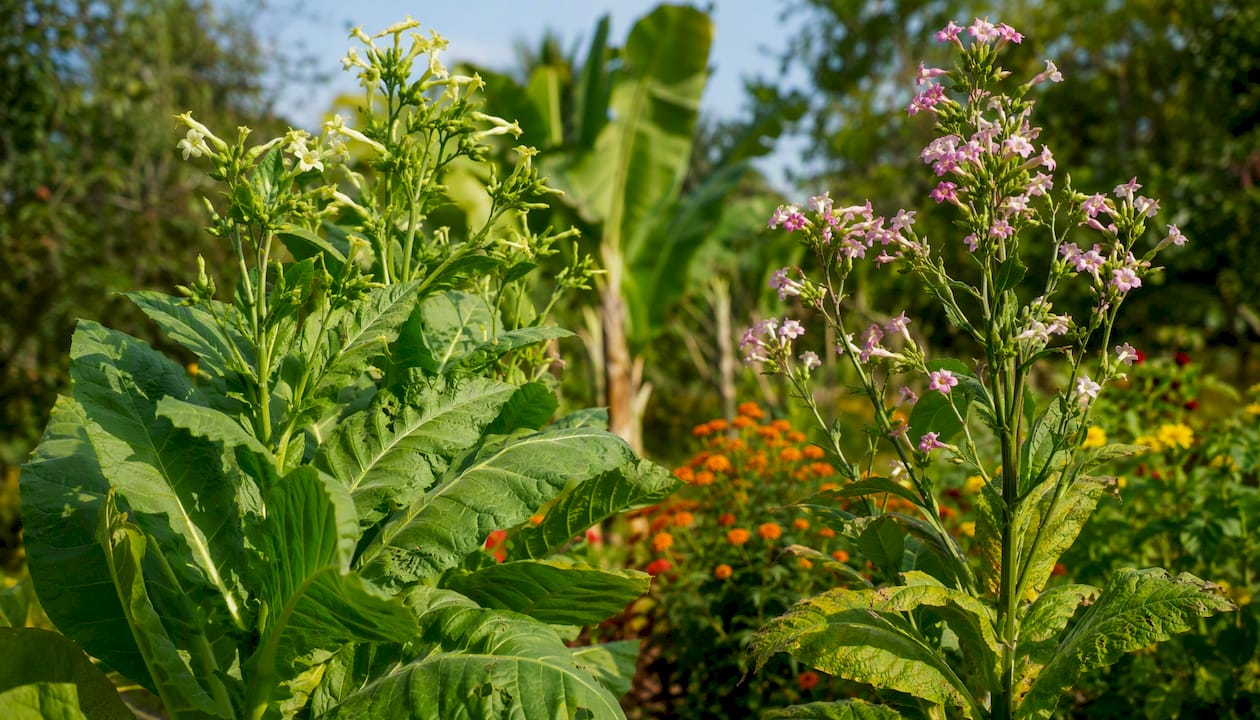
The chemical difference between the two species is substantial. N. rustica typically carries nicotine concentrations several times higher than N. tabacum on a dry-weight basis, and it also contains a richer profile of minor alkaloids: nornicotine, anabasine, and anatabine appear in measurable quantities alongside the dominant nicotine. Wikipedia's botanical profile of N. rustica notes its historical use as an insecticidal extract and stimulant snuff, reflecting just how potent the plant's alkaloid load is compared to its commercial cousin.
Comparing N. rustica and N. tabacum for rapé use
| Feature | Nicotiana rustica (mapacho) | Nicotiana tabacum (commercial tobacco) |
|---|---|---|
| Typical nicotine (dry weight) | Substantially higher; several times that of N. tabacum | Lower; basis for most commercial products |
| Key minor alkaloids | Nornicotine, anabasine, anatabine (notable levels) | Nornicotine, anabasine, anatabine (lower levels) |
| Traditional rapé role | Primary ingredient; pharmacological and ceremonial core | Occasionally used in some blends; not the traditional base |
| Curing method for rapé | Sun-cured or low-fire air-cured; preserves alkaloid profile | Often flue-cured or fire-cured for commercial use |
| Vernacular names | Mapacho, real tobacco, wild tobacco, rustic tobacco | Common tobacco, Virginia tobacco, burley |
| Geographic origin for rapé | Amazon basin, Andes; cultivated by many indigenous groups | Widely cultivated globally; not specific to Amazonian tradition |
Traditional varieties used in rapé preparations include corda (a twisted, rope-cured form common in Brazilian Amazonian traditions) and moi (a softer, milder-cured leaf used by certain lineages in Peru). The choice of variety, curing method, and harvest stage all shape the final alkaloid profile. Leaves harvested at full maturity and sun-cured at low temperatures tend to retain more of the intact nicotine and minor alkaloids, while fire-curing introduces additional combustion by-products.
Geographically, mapacho cultivation spans the Amazon basin from the Peruvian and Colombian headwaters through Brazil, and extends into the Andean foothills. Indigenous groups including the Huni Kuin, Yawanawá, and Shipibo have cultivated specific landrace varieties for generations, each with distinct sensory and ceremonial characteristics. The plant's names vary accordingly: mapacho in much of the Spanish-speaking Amazon, tabaco or tabaco bravo in some Andean contexts, and lineage-specific names within individual communities.
How is rapé traditionally prepared?
Rapé is not a simple ground tobacco. Its preparation is a multi-stage process embedded in lineage-specific protocols, and each step shapes both the chemistry and the ceremonial integrity of the final blend.
The core preparation sequence
- Harvest. Mature N. rustica leaves are harvested by hand, typically at full leaf development when alkaloid content peaks. Many practitioners harvest during specific lunar phases or seasons according to lineage tradition.
- Cure. Leaves are sun-dried or low-fire air-cured over days to weeks. This step reduces moisture, concentrates alkaloids, and begins developing the characteristic earthy, resinous aroma of mapacho.
- Dry. After initial curing, leaves are further dried until they reach a low-moisture state suitable for pulverizing without clumping.
- Pulverize. Dried leaves are ground using traditional wooden mortars and pestles or stone grinding tools. Prayers and lineage-specific intentions are often spoken or sung during this stage, embedding ceremonial meaning into the physical process.
- Sieve. The ground material passes through fine sieves repeatedly to achieve a uniform, ultra-fine powder. Coarser particles are re-ground or discarded.
- Prepare ash. Tree bark or wood from species such as Tsunu (Platycyamus regnellii), Cumaru, or copaíba is burned to ash, then sieved to remove charcoal particles and achieve a fine, pale powder.
- Blend. Tobacco powder and ash are combined at lineage-specific ratios. Optional botanical admixtures are added at this stage.
- Final sieve. The blended mixture passes through fine sieves again to integrate all components and remove any remaining coarse material.
Common admixtures and ash sources
The ash is not filler. It is the pH-raising agent that converts bound nicotine into free-base form, and its source carries its own ceremonial significance. Common ash sources and botanical admixtures include:
- Copaíba resin or bark: Used in some blends for its resinous, balsamic notes and reported anti-inflammatory properties; copaíba-based blends are among the more distinctive preparations available.
The 7 Ervas Hapé blend illustrates how multiple botanical ingredients combine in a single preparation, each contributing its own character to the overall effect.
Pro Tip: Repeated sieving and thorough removal of charcoal particles from the ash matters for two reasons: unburned carbon particles can cause unnecessary nasal irritation, and coarse ash creates uneven pH distribution in the final blend. Fine, pale ash is the mark of careful preparation.
Ash ratios vary widely across lineages and makers. Higher ash proportions raise pH further, increasing free-base nicotine and intensifying nasal sensation. Lower ratios produce a milder, more tobacco-forward blend. Neither is inherently superior; the ratio reflects the maker's intention and the ceremony's purpose.
What does the chemistry of rapé actually reveal?
The peer-reviewed chemistry of rapé is more striking than most practitioners realize. Stanfill et al.'s comprehensive chemical characterization measured total nicotine in hand-made rapé samples varying widely among products, a range that reflects genuine variability across lineages, ash ratios, and tobacco varieties. For context, many commercial smokeless tobacco products contain far lower un-ionized nicotine fractions because their pH is lower.
The pH and free-base nicotine mechanism
Nicotine exists in two forms in any tobacco preparation: ionized (protonated, poorly absorbed through mucous membranes) and un-ionized, or free-base (rapidly absorbed). The ratio between them is almost entirely determined by pH. At the alkaline pH values produced by plant ash, the equilibrium shifts sharply toward free-base nicotine.
Key measurement: Hand-made rapé preparations reach pH 9.75–10.2, producing calculated un-ionized nicotine values up to 18.5 mg/g in high-pH samples. This is the chemical explanation for rapé's rapid and intense nasal effects.
The same analytical work, confirmed by CDC Stacks' version of the study, used Fourier transform infrared spectroscopy (FT/IR) and gas chromatography/mass spectrometry (GC/MS) to identify species composition and non-tobacco constituents. These methods confirmed the presence of N. rustica in analyzed samples and identified PAHs in products where fire-cured tobacco or incompletely burned ash was present.
Minor alkaloids: nornicotine, anabasine, and anatabine
Beyond nicotine, rapé made from N. rustica contains measurable quantities of:
- Nornicotine: A metabolite and co-occurring alkaloid; contributes to overall nicotinic activity and may have its own pharmacological effects, though its specific role in rapé's effects is not fully characterized.
- Anabasine: A structural analog of nicotine; binds nicotinic acetylcholine receptors and has been associated with toxicity at higher doses.
- Anatabine: Present in lower concentrations; its pharmacological contribution in the rapé context remains uncertain.
These alkaloids add complexity to the pharmacological picture. Rapé is not simply a nicotine delivery system; it is a multi-alkaloid preparation whose full interaction profile has not been comprehensively studied.
Tobacco-specific nitrosamines (TSNAs) and polycyclic aromatic hydrocarbons (PAHs)
TSNAs are formed during curing and processing of tobacco and are classified by the International Agency for Research on Cancer (IARC) as probable or known human carcinogens. PAHs arise from combustion processes, including the burning of wood or bark to produce ash. Both classes of compounds have been identified in analyzed rapé samples.
| Constituent | Presence in rapé samples | IARC classification | Notes |
|---|---|---|---|
| Total nicotine | 6.32–47.6 mg/g (measured range) | Not classified as carcinogen | Primary psychoactive alkaloid |
| Un-ionized nicotine | Up to 18.5 mg/g (high-pH samples) | Not classified as carcinogen | Drives nasal bioavailability |
| TSNAs (e.g., NNN, NNK) | Detected in analyzed samples | Group 1 / Group 2A (IARC) | Levels vary by curing method and tobacco variety |
| PAHs (e.g., benzo[a]pyrene) | Detected in fire-cured/ash samples | Group 1 (benzo[a]pyrene, IARC) | Associated with ash production method |
| Nornicotine, anabasine, anatabine | Detected; levels vary | Not individually classified | Pharmacological roles in rapé not fully studied |
These findings come from a limited number of samples and should not be generalized to all rapé preparations. Variability across lineages, curing methods, and ash sources is substantial. The data establishes that toxicants are present and measurable, not that every preparation carries identical risk.
What role does mapacho play in Amazonian ceremony?
The chemistry explains potency. It does not explain why mapacho has been central to Amazonian healing traditions for centuries. That requires a different frame entirely.
Ethnopsychological research on Amazonian traditional medicine documents N. rustica as a master plant and "father of plants" in Peruvian and broader Amazonian traditions, used in multiple forms including smoke, infusion (drinking tobacco), singado (nasal liquid insufflation), and dry snuff. Practitioners describe mapacho not as a substance but as a presence: a teacher, a protector, and a guide whose cooperation must be earned through respect, diet, and lineage protocol.
Johannes Wilbert's monograph Tobacco and Shamanism in South America provides the broadest historical framing, documenting tobacco's role across dozens of South American cultures as a medium for communication with spirits, a vehicle for healing intent, and a substance whose power is inseparable from the knowledge and lineage of the person working with it.
Ceremonial functions attributed to mapacho and rapé across various lineages include:
- Grounding and centering: Rapé is often used at the opening of ceremony to bring participants into the body and the present moment.
- Protection and cleansing: Many traditions use mapacho smoke or rapé to clear energetic disturbances and establish ceremonial boundaries.
- Modulating other plant medicines: Rapé is commonly used before, during, or after ayahuasca ceremonies to ground participants, clear purging, or seal the work.
- Focus and clarity: Smaller doses are used by some practitioners for mental clarity during dieta or plant medicine work.
- Sealing ceremony: A final application of rapé often marks the close of a ceremony, signaling a return to ordinary awareness.
Ethnographic field research documents lineage-specific purification and apprenticeship protocols governing who may prepare and administer mapacho, under what conditions, and with what prayers. Gendered knowledge transmission is significant in several traditions: certain preparations or roles are specific to men or women within a lineage, and this specificity is understood as part of the medicine's integrity.
Respect for these protocols is not ceremonial decoration. It is the framework within which the plant's power is understood to operate safely and beneficially. Working with rapé outside of lineage guidance, particularly at high doses, carries real risks that the ceremonial container is designed to manage.
How is rapé administered, and what should you expect?
Rapé is administered nasally using one of two traditional tools. Understanding both helps you make an informed choice about how to approach the medicine.
Kuripé and tepi: the two application methods
A kuripé is a V-shaped self-applicator, typically carved from wood or bone, with one end placed in the nostril and the other in the mouth. The user blows the rapé into their own nostril with a single, firm breath. This method supports self-directed practice and personal ceremony. Handcrafted kuripes and tepis vary in design, material, and lineage tradition.
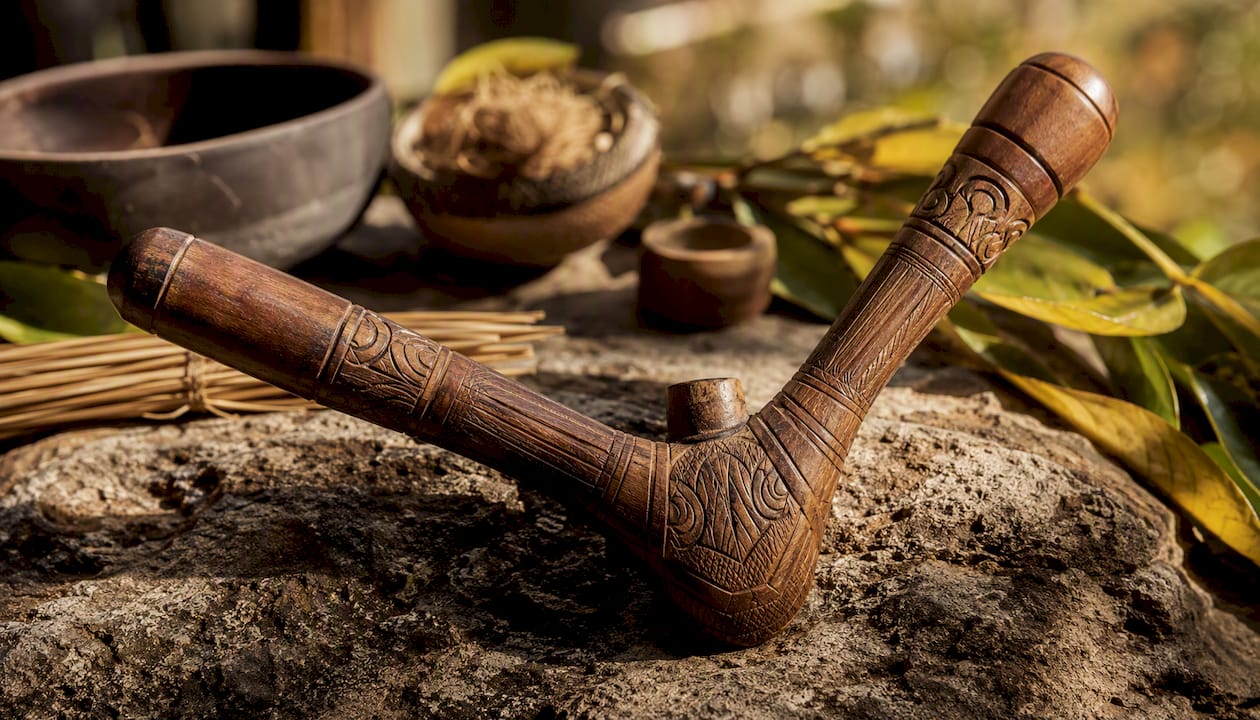
A tepi is a longer blowpipe used by a facilitator to administer rapé to another person. The facilitator places one end at the recipient's nostril and blows through the other. In traditional ceremony, the facilitator's breath, intention, and sometimes song or prayer are considered part of the medicine itself. The tepi is the preferred tool in formal ceremonial contexts.
Typical serving sizes vary by lineage and blend potency. A conservative starting amount for a new practitioner is a small pinch per nostril, roughly the size of a pea. Experienced practitioners may use larger amounts, but starting small is always the safer approach.
What to expect: timeline and common responses
- Onset (seconds to 2 minutes): Immediate nasal sensation, often described as a sharp clearing or burning, followed by rapid onset of physiological effects including increased heart rate, salivation, and tearing.
- Peak (2–10 minutes): Strongest effects, which may include dizziness, nausea, a strong urge to purge (vomit or expectorate), and a pronounced shift in awareness or body sensation.
- Settling (10–30 minutes): Effects begin to stabilize; many practitioners describe a grounded, clear, focused state emerging as the acute phase passes.
- Duration (up to 45–90 minutes): Residual effects, including nasal clearing and a calm, centered quality, may persist for an hour or more depending on dose and blend.
For a detailed guide to using rapé for nervous-system regulation, the rapé nervous system reset technique offers practical, step-by-step guidance from experienced practitioners.
Harm reduction: what you need to know before using rapé
- Do not use rapé if you are pregnant, nursing, or have cardiovascular disease, uncontrolled hypertension, or a history of cardiac arrhythmia.
- Avoid combining rapé with MAO inhibitors (including ayahuasca) without explicit guidance from a trained lineage practitioner, as the combination can produce dangerous cardiovascular effects.
- Start with the smallest possible dose. The potency of mapacho-based blends is not predictable from prior experience with commercial tobacco.
- Have a trusted sitter present for your first sessions, particularly if using a tepi.
- Keep water nearby for aftercare; rinsing the nasal passages after the acute phase is common practice.
- Seek immediate medical attention for chest pain, sustained arrhythmia, or loss of consciousness.
Aftercare and integration matter as much as the experience itself. Sitting quietly, journaling, or spending time in nature after a rapé session supports the grounding and clarity that practitioners describe as the medicine's gift.
What are the health risks and legal status of rapé in the United States?
The health risks of rapé are real and measurable. The legal picture in the United States is less straightforward than many buyers assume.
Evidence-based health risks
The chemical analysis of rapé samples establishes several categories of concern:
- Acute nicotine toxicity: Total nicotine up to 47.6 mg/g in some samples means that even a small serving delivers a pharmacologically significant nicotine dose. Symptoms of acute nicotine toxicity include nausea, vomiting, rapid heart rate, elevated blood pressure, and, at high doses, seizure or respiratory depression.
- Cardiovascular stress: Free-base nicotine absorbed rapidly through nasal mucosa produces a sharp cardiovascular response. For individuals with pre-existing heart conditions or hypertension, this response carries genuine risk.
- Carcinogenic compounds: TSNAs and PAHs detected in analyzed samples are classified by IARC as probable or known human carcinogens. The long-term risk from nasal exposure to these compounds at rapé-relevant doses has not been systematically studied.
- Dependence potential: Nicotine is one of the most addictive substances known. Regular rapé use carries a real risk of nicotine dependence, regardless of the ceremonial context.
Sampling caveat: All figures above come from a limited set of analyzed samples. Actual levels vary substantially across lineages, ash sources, and preparation methods. These numbers establish that risk exists; they do not define a universal exposure level.
Contraindications
- Pregnancy or nursing
- Cardiovascular disease or history of cardiac arrhythmia
- Uncontrolled hypertension
- Active psychiatric conditions, particularly psychosis or mania
- Current use of MAO inhibitors or certain antidepressants
- Nicotine replacement therapy or recent cessation products
Legal and regulatory context in the United States
Rapé that contains tobacco falls under the jurisdiction of the U.S. Food and Drug Administration (FDA) as a tobacco product under the Family Smoking Prevention and Tobacco Control Act. The FDA's authority extends to products made or derived from tobacco intended for human consumption, which includes nasal tobacco preparations. Regulatory treatment of specific imported or artisanal rapé blends can be complex, and the landscape continues to evolve.
The Plants For A Future profile of N. rustica notes the plant's toxicity profile and cautions about nicotine content throughout all plant parts, which is relevant context for anyone considering cultivation or handling of raw plant material.
Readers should consult the FDA's current guidance and, where relevant, a qualified legal or medical professional for up-to-date regulatory information specific to their situation. This article does not constitute legal advice.
What does the research on ash pH tell us about rapé's potency?
The relationship between ash, pH, and free-base nicotine is the single most important piece of chemistry for understanding why rapé works the way it does, and why potency varies so dramatically across preparations.
Published measurement: Hand-made rapé preparations have been measured at high alkaline pH levels, with correspondingly elevated calculated un-ionized (free-base) nicotine values in the highest-pH samples. At neutral pH (7.0), the vast majority of nicotine is ionized and poorly absorbed nasally. At pH 10, the equilibrium shifts dramatically toward the free-base form.
The practical implications of this chemistry are significant:
- Higher ash ratios raise pH further, increasing the proportion of free-base nicotine and intensifying both the speed of onset and the depth of physiological effect.
- Finer ash particle size distributes the alkaline material more evenly through the blend, producing more consistent pH across the preparation rather than localized hot spots.
- Coarser or incompletely burned ash introduces charcoal particles that can cause nasal irritation without contributing to pH elevation, and may increase PAH exposure.
- Variability is the norm, not the exception. Measured total nicotine ranged from 6.32 to 47.6 mg/g across sampled products, reflecting genuine differences in tobacco variety, curing method, ash source, and blend ratio.
This variability has a direct safety implication: a dose that is mild with one blend may be overwhelming with another. Practitioners who work across multiple lineages and preparations consistently report that each blend requires its own calibration.
The current body of peer-reviewed chemistry is built on a relatively small number of samples. Systematic pairing of chemical analysis with ethnographic documentation of specific lineage preparations would substantially advance both safety knowledge and cultural understanding. That work remains largely undone.
Where can you find ethically sourced rapé in the United States?
The U.S. market for rapé has grown considerably, and with that growth has come real variation in sourcing quality, transparency, and cultural respect. Knowing what to look for protects both you and the communities whose traditions you are engaging with.
Ethical sourcing checklist
- Lineage attribution: Does the vendor identify which indigenous community or lineage produced the blend? Anonymous "Amazonian rapé" with no origin information is a red flag.
- Fair payment to makers: Ethical vendors document that indigenous makers receive fair compensation, not token payments that extract cultural knowledge without reciprocity.
- Sustainable ash tree harvesting: Tsunu, Cumaru, and other ash-source trees are harvested from living forests. Unsustainable harvesting threatens both the ecosystem and the cultural practice.
- Ingredient transparency: A reputable vendor lists the primary tobacco base, ash source, and any botanical admixtures. Undisclosed additives are a concern both culturally and chemically.
- Testing and safety documentation: Ask whether the vendor has had blends tested for heavy metals, pesticides, or other contaminants. Few vendors currently provide this, but it is a reasonable question to ask.
Buying tips for U.S. consumers
- Look for clear origin statements that name the specific community, region, and lineage, not just a country of origin.
- Prefer vendors who describe particle fineness and ash source, as these directly affect potency and safety.
- Avoid blends with undisclosed "proprietary" ingredients or those marketed primarily on potency claims rather than lineage and tradition.
- Ask vendors directly about their relationships with producing communities and whether those communities have approved the sale and distribution of their preparations.
Many rapé blends available in the United States are imported from Brazil or Peru, though some are crafted domestically by practitioners trained in Amazonian lineages. Both can be ethically sourced; the key is transparency and documented relationships with producing communities. For broader context on herbal healing traditions and what ethical sourcing looks like across plant medicine categories, reputable educational resources can help frame your expectations.
The Amazonian healing traditions overview from Pillars of Light hap'e provides useful cultural context for understanding the communities and lineages behind these preparations.
A perspective on respectful engagement with mapacho
There is a version of the rapé conversation that stays entirely in the chemistry, and another that stays entirely in the spiritual. Neither is complete on its own.
The measured pH values, the free-base nicotine calculations, the TSNA detections: these are real and they matter. Anyone working with rapé deserves to understand what they are actually putting in their body. At the same time, reducing mapacho to a nicotine delivery system misses something fundamental about why these traditions have persisted for generations and why practitioners describe effects that go well beyond what the alkaloid profile alone would predict.
What strikes us most, after sitting with both the chemistry and the ethnographic record, is how much the ceremonial container does. The lineage protocols, the prayers during preparation, the trained facilitator, the intention set before application: these are not decoration. They are the framework within which a potent and potentially dangerous plant is worked with safely and meaningfully. The chemistry explains the mechanism. The tradition explains the medicine.
Our commitment at Pillars of Light hap'e is to hold both frames honestly. That means:
- Being transparent about what is in every blend we carry, including ash source and botanical admixtures.
- Supporting the indigenous communities whose knowledge makes these preparations possible.
- Recommending that new practitioners learn from trained facilitators before working with rapé independently.
- Never marketing potency as a virtue divorced from context and safety.
Mapacho is a teacher. Teachers deserve respect, preparation, and the right relationship. The chemistry tells you what it can do. The tradition tells you how to approach it well.
Pillars of Light hap'e: ethically sourced rapé and ceremonial tools
75+ varieties of traditionally prepared rapé, sourced directly from Amazonian lineages and shipped from Old Town Spring, Texas. That is what Pillars of Light hap'e offers. The sourcing documentation behind each blend is what sets it apart from the anonymous imports that dominate most online marketplaces.
Every blend in the collection comes with lineage attribution, ash source identification, and botanical ingredient disclosure. The ceremonial items collection includes handcrafted kuripes and tepis made by Amazonian artisans, so you can work with tools that carry the same care and intention as the medicine itself. For practitioners ready to go deeper, the master plant allies page connects you with the broader context of Amazonian plant medicine traditions. Browse the full collection, read the sourcing notes, and reach out with questions. The next step is yours to take.
Sources
The sources below were selected for primary data, peer review, or long-standing ethnographic authority. Chemistry papers provide measured values; ethnographic accounts provide cultural context. Neither is sufficient without the other.
- Comprehensive chemical characterization of Rapé tobacco products: Nicotine, un-ionized nicotine, tobacco-specific N′-nitrosamines, polycyclic aromatic hydrocarbons, and flavor constituents
- Comprehensive Chemical Characterization of Rapé Tobacco Products: Nicotine, Un-ionized Nicotine, Tobacco-specific N’-Nitrosamines, Polycyclic Aromatic Hydrocarbons, and Flavor Constituents - CDC Stacks
- Indigenous Amazonian tobacco use and therapeutic practices (ethnographic source)
- Tobacco and Shamanism in South America (Yale University Press)
This article is general information, not a substitute for advice from a qualified doctor. Consult a qualified healthcare professional about your own circumstances before acting on anything here.